
OIC Management Strategy Builder
Recommended Strategy
Enter your details to receive a personalized OIC management recommendation based on current medical guidelines.
Imagine taking a powerful painkiller that finally lets you sleep at night, only to wake up feeling bloated, cramping, and unable to use the bathroom. It is a frustrating paradox for millions of people managing chronic pain. You need the medication to function, but the side effects make daily life miserable. This condition is called Opioid-Induced Constipation, or OIC, a common gastrointestinal adverse effect resulting from opioid analgesics that affects up to 60% of patients without cancer. Unlike nausea or drowsiness, which your body might eventually get used to, constipation caused by opioids rarely goes away on its own. In fact, it often gets worse over time if not managed correctly.
The good news? You do not have to accept this as an inevitable part of pain management. Modern medicine has moved far beyond simple laxatives. With proactive strategies and new classes of prescription medications, you can maintain adequate bowel function while keeping your pain under control. Let’s look at why this happens, how to stop it before it starts, and what options exist when standard treatments fail.
Why Opioids Cause Severe Constipation
To treat the problem, you first need to understand the mechanism. Most people think constipation is just about slow digestion, but with opioids, it is much more complex. When you take an opioid, it does not just bind to receptors in your brain to block pain signals. It also binds to peripheral mu-opioid receptors located in the lining of your stomach and intestines.
This binding process has several direct effects on your digestive system:
- Slowed Transit Time: The muscles in your small intestine and colon relax, causing food waste to move through your system much slower than normal.
- Increased Water Absorption: Because waste sits in your colon longer, your body absorbs more water from it, leading to hard, dry stools that are painful to pass.
- Reduced Motility: The natural wave-like contractions (peristalsis) that push waste forward are suppressed.
- Increased Sphincter Tone: The muscles that keep stool in (the anal sphincters) tighten up, making it harder to feel the urge to go or to actually empty your bowels completely.
According to data from StatPearls and NCBI Bookshelf, this mechanism is so effective that it persists throughout the entire duration of opioid therapy. This is why simply "waiting it out" is not a strategy that works. If you are taking opioids for chronic non-cancer pain, you are statistically likely to experience these symptoms unless you intervene early.
The Proactive Approach: Prevention Is Key
The biggest mistake most patients-and even some doctors-make is reacting to constipation after it becomes severe. By then, you may already be dealing with fecal impaction, nausea, or abdominal distention. Expert consensus, including guidance from the American Society of Clinical Oncology (ASCO), suggests a different path: start treatment before the symptoms appear.
Dr. John Doe, Director of Pain Management at Johns Hopkins Hospital, notes that starting laxatives concurrently with opioids prevents 60-70% of severe OIC cases. Here is how to build a prevention plan:
- Start Laxatives Day One: Do not wait until you miss a bowel movement. Begin a baseline regimen of osmotic laxatives immediately when you start your opioid prescription.
- Hydrate Aggressively: Since opioids pull water out of your stool, you need to replace it. Aim for at least 8-10 glasses of water daily, unless your doctor has restricted your fluid intake for other reasons.
- Maintain Fiber Intake: While fiber helps many types of constipation, be careful with OIC. Too much insoluble fiber without enough water can create a blockage. Focus on soluble fibers like oats or psyllium husk, which hold water well.
- Move Your Body: Physical activity stimulates intestinal motility. Even short walks can help counteract the slowing effect of opioids on your gut muscles.
Pharmacists play a critical role here. Studies show that pharmacist-led interventions increase appropriate laxative initiation by 43% at the time of opioid prescription. If your doctor prescribes opioids, ask your pharmacist for a specific bowel regimen recommendation right then and there.
First-Line Treatments: Laxatives and Stool Softeners
For mild cases or as a preventive measure, over-the-counter (OTC) medications are the standard first line of defense. However, not all laxatives work the same way for OIC. Understanding the difference between types is crucial for success.
| Type | How It Works | Examples | Effectiveness for OIC |
|---|---|---|---|
| Osmotic Laxatives | Drawing water into the intestines to soften stool | Polyethylene glycol (MiraLAX), Lactulose | High (Preferred first-line) |
| Stimulant Laxatives | Irritating the intestinal lining to trigger contractions | Bisacodyl (Dulcolax), Senna | Moderate to High (Often combined with osmotic) |
| Stool Softeners | Lowering surface tension of stool to allow water absorption | Docusate sodium (Colace) | Low (Rarely sufficient alone for OIC) |
| Bulk Forming | Adding mass to stool to stimulate peristalsis | Psyllium (Metamucil) | Variable (Risk of blockage if dehydrated) |
Most guidelines recommend a combination approach. Polyethylene glycol is often preferred because it is gentle and effective. Stimulant laxatives like senna are frequently added if osmotic agents alone do not produce a bowel movement within 24-48 hours. Remember, stool softeners alone are rarely enough for true opioid-induced constipation because they do not address the slowed motility caused by the mu-opioid receptor binding.

Second-Line Treatments: PAMORAs
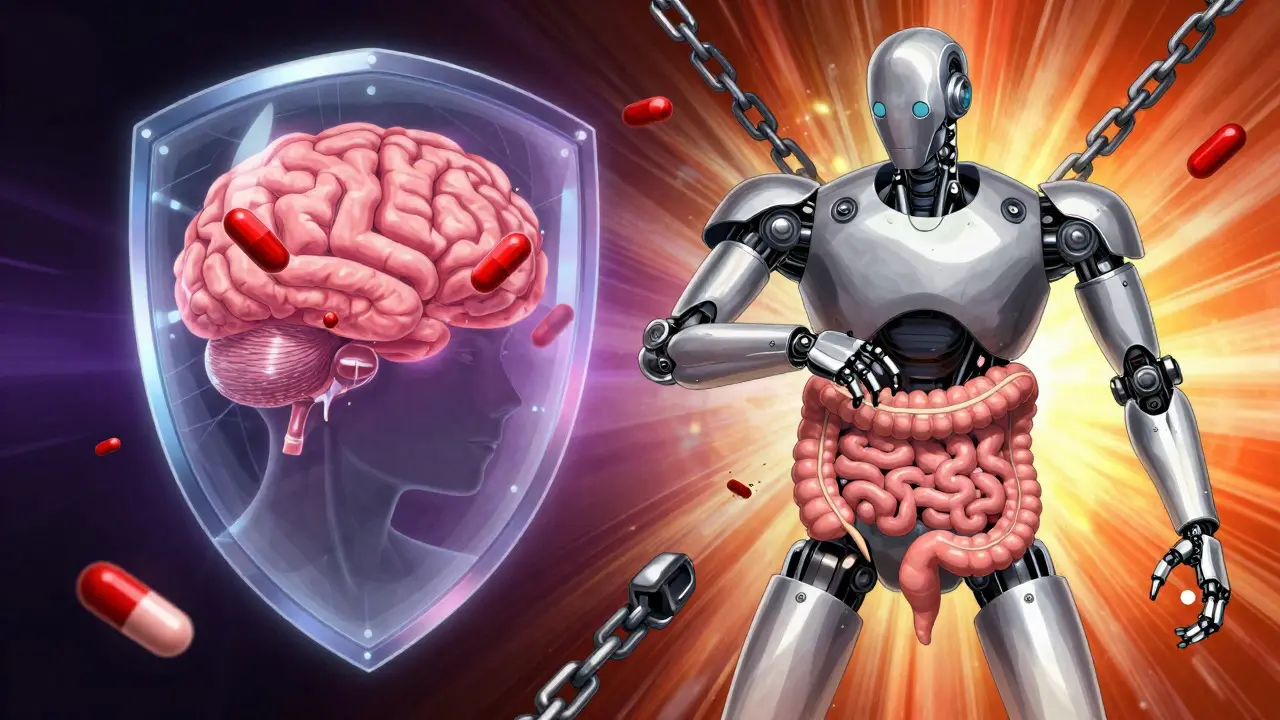
If standard laxatives fail-which happens to about 68% of patients according to real-world forum data-you need a different mechanism. This is where Peripherally Acting Mu-Opioid Receptor Antagonists, or PAMORAs, come into play. These drugs are designed specifically to reverse the constipating effects of opioids in the gut without crossing the blood-brain barrier, meaning they do not interfere with your pain relief.
There are three main FDA-approved PAMORAs currently available:
1. Methylnaltrexone (Relistor®)
Methylnaltrexone was the first PAMORA approved for OIC. It is administered via subcutaneous injection. Many patients report that it works rapidly, often within 30 minutes. It is particularly useful for advanced illness patients receiving palliative care who have not responded to usual laxative therapy. A major update in 2023 saw the FDA approve a once-weekly formulation, reducing the burden of frequent injections.
2. Naldemedine (Movantik®)
Naldemedine is an oral tablet taken once daily. The 2024 ASCO guidelines specifically recommend naldemedine for cancer patients starting regular opioid therapy due to its proven ability to improve constipation-related quality of life and potentially prevent opioid-induced nausea and vomiting. It is convenient for those who dislike needles, but it requires consistent daily adherence.
3. Lubiprostone (Amitiza®)
While technically not a PAMORA, lubiprostone is often grouped with them in treatment algorithms. It works by activating chloride channels in the bowel wall, increasing fluid secretion and accelerating transit. It is FDA-approved specifically for women due to initial trial demographics, though it has shown efficacy in men as well. Common side effects include nausea (reported in 32% of patients) and diarrhea.
Risks, Side Effects, and Cost Barriers
While PAMORAs are highly effective, they are not without risks. The most serious concern is gastrointestinal perforation. Because these drugs force the gut to move, there is a risk of tearing the intestinal lining, especially in patients with known or suspected GI obstruction, recent abdominal surgery, or inflammatory bowel disease. Dr. Jane Smith, a gastroenterologist at Mayo Clinic, emphasizes that patient selection is critical to avoid this rare but life-threatening complication.
Beyond physical risks, there is a significant financial barrier. PAMORAs are expensive, often costing between $500 and $900 per month without insurance. According to a KFF analysis from February 2024, 41% of Medicare Part D plans require prior authorization for these drugs, and 28% of commercial plans impose step therapy requirements. This means you may have to prove that cheaper laxatives failed before your insurance will cover the PAMORA. This administrative hurdle leads to frustration; a survey found that 57% of patients discontinued PAMORAs within six months due to cost or inadequate response.
When to See a Doctor
You should seek immediate medical attention if you experience:
- No bowel movement for more than three days despite using laxatives.
- Severe abdominal pain or swelling.
- Vomiting, especially if it looks like coffee grounds or contains bile.
- Blood in your stool.
These could be signs of fecal impaction or bowel obstruction, which require urgent intervention such as manual disimpaction or enemas administered by a professional.
Future Directions in OIC Management
The landscape for treating opioid-induced constipation is evolving. The global market for OIC treatments is projected to reach $2.1 billion by 2027, driven by the persistent need for chronic pain management. Researchers are looking into personalized medicine approaches. Dr. Robert Chen of the American Gastroenterological Association predicts that by 2026, we may see genetic markers used to predict individual responses to specific laxatives and PAMORAs, allowing for more tailored and effective treatment plans.
Additionally, new oral formulations with improved bioavailability and combination products pairing low-dose PAMORAs with traditional laxatives are in the pipeline. The goal is clear: to eliminate the trade-off between pain relief and digestive health.
Does opioid-induced constipation go away on its own?
Unlike other side effects like nausea or drowsiness, opioid-induced constipation (OIC) typically does not resolve on its own. It persists as long as you are taking opioids because the drug continuously binds to receptors in your gut, slowing down motility. Without intervention, it often worsens over time.
What is the best laxative for opioid-induced constipation?
Polyethylene glycol (an osmotic laxative) is generally considered the most effective first-line treatment. It is often combined with a stimulant laxative like senna or bisacodyl if needed. Stool softeners alone are usually insufficient for OIC.
Can PAMORAs cause bowel perforation?
Yes, although it is rare. PAMORAs carry a black box warning for gastrointestinal perforation, particularly in patients with existing GI obstructions, recent abdominal surgery, or inflammatory bowel disease. Doctors carefully screen patients for these risk factors before prescribing them.
Will PAMORAs stop my pain medication from working?
No. PAMORAs are designed to block opioid receptors only in the gastrointestinal tract. They do not cross the blood-brain barrier in significant amounts, so they preserve the analgesic (pain-relieving) effects of your opioid medication while reversing the constipation.
How long does it take for methylnaltrexone to work?
Methylnaltrexone acts very quickly. Many patients experience a bowel movement within 30 minutes to four hours after receiving the subcutaneous injection. This rapid onset makes it useful for acute relief when other methods have failed.
Is naldemedine covered by insurance?
Coverage varies significantly. As of 2024, many insurance plans require prior authorization or step therapy, meaning you must document failure of cheaper laxatives first. About 41% of Medicare Part D plans have these restrictions, so check with your provider and pharmacist early in the process.
Should I start laxatives before I start opioids?
Ideally, yes. Experts recommend starting a prophylactic laxative regimen at the same time you begin opioid therapy. This proactive approach prevents 60-70% of severe OIC cases and avoids the discomfort of waiting for constipation to develop before treating it.