
When you’re 75 or older, taking a pill isn’t as simple as it was at 40. Your kidneys don’t work the same way anymore. That’s not a myth-it’s biology. About 30% of the medications seniors take leave the body through the kidneys. If those kidneys aren’t filtering properly, drugs build up. And that’s how you end up with dizziness, confusion, falls, or even kidney damage from a pill meant to help.
Most doctors know this. But here’s the problem: they’re often using the wrong math to figure out how well those kidneys are working. Many electronic health records still default to equations designed for younger, healthier people. That’s like using a child’s shoe size to fit an adult. It doesn’t work. And the consequences? Real. In one study, 30% of seniors had their kidney function misclassified because of outdated formulas. That means someone could be getting a dose that’s too high-or too low-because the system got the numbers wrong.
Why Kidney Function Changes with Age
Your kidneys start slowing down in your 30s. By 70, the average person has lost about 35% of their kidney filtering capacity. That’s not disease. That’s aging. Nephrons-the tiny filters inside your kidneys-die off. Blood flow to the kidneys drops. Muscle mass decreases, which changes how creatinine (a waste product) is made and cleared.
That’s why serum creatinine alone is misleading. A senior might have a "normal" creatinine level, but that’s only because they’ve lost muscle. Lower muscle = less creatinine = falsely high eGFR. That’s the trap. It looks like their kidneys are fine. But they’re not. That’s why relying on just one number is dangerous.
The Equations Used to Estimate Kidney Function
There are several formulas doctors use to estimate how well your kidneys are working. They’re called eGFR equations. But not all of them are made for seniors.
- Cockcroft-Gault (CG): Developed in 1976. It uses your age, weight, gender, and serum creatinine. It’s old, but it’s still used-especially for dosing drugs like vancomycin or aminoglycosides. But here’s the catch: if you use your actual body weight, it overestimates kidney function in obese seniors and underestimates it in frail ones. The fix? Use ideal body weight instead. Studies show this reduces dosing errors by 25% in older adults.
- MDRD: Created in 1999. It’s better than CG for some groups, but it’s biased in seniors. It tends to underestimate kidney function in older people, especially those over 75. That means it might label someone as having stage 3 kidney disease when they really don’t.
- CKD-EPI: Introduced in 2009. This is the most common one in hospitals today. It’s better than MDRD for people with mild kidney issues. But for very old adults-especially those who are thin, frail, or malnourished-it still misses the mark. In one study, CKD-EPI misclassified 40% of patients over 80 compared to the gold standard.
- BIS1 and FAS: These are newer. BIS1 (Berlin Initiative Study 1) and FAS (Full Age Spectrum) were designed specifically for seniors. They account for age-related muscle loss and body composition changes. In patients over 75, BIS1 is 17% more accurate than CKD-EPI. It’s the equation that geriatric nephrologists use when they really want to get it right.
- Serum Cystatin C: This is a different kind of marker. Unlike creatinine, it’s not affected by muscle mass. It’s more accurate in frail seniors. But it costs $50-$75 more than a creatinine test. So it’s not always used-but it should be when the stakes are high.
Which Equation Should You Use?
There’s no single "best" equation for everyone. But here’s what works in real life:
- For frail, thin, or malnourished seniors over 75: Use BIS1. If you can, add a cystatin C test. This combo cuts medication errors by up to 18%.
- For obese seniors: Use Cockcroft-Gault with ideal body weight. Don’t use actual weight-it inflates the number.
- For seniors with diabetes or high blood pressure: Check urine albumin-to-creatinine ratio annually. That tells you if there’s kidney damage, not just reduced function.
- For critical drugs like dabigatran, rivaroxaban, or colistin: Don’t rely on any equation alone. Use a 24-hour urine collection for creatinine clearance. It’s the only way to be sure.
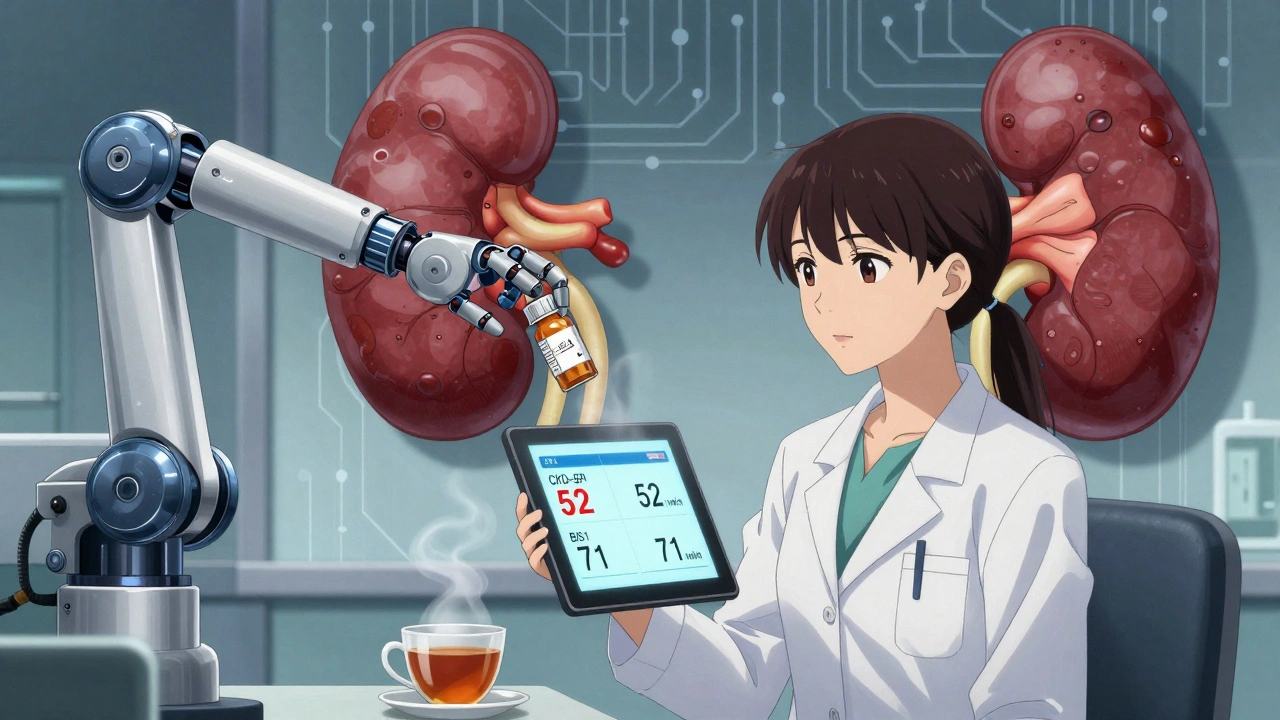
Here’s a real example: A 88-year-old woman with dementia and weight loss had a CKD-EPI eGFR of 52 mL/min/1.73 m². Her doctor assumed she had stage 3 kidney disease and cut her dose of rivaroxaban. But when they switched to BIS1, her eGFR jumped to 71. She was getting too little medication. Switching back to the full dose prevented a stroke. That’s the kind of mistake that happens when you use the wrong formula.
What Clinicians Are Doing Right (and Wrong)
A 2023 survey found that 65% of primary care doctors are unsure which equation to pick. Many just let their EHR choose for them. That’s risky. Epic Systems now auto-selects BIS1 for patients over 75. But not all systems do that. And even when they do, pharmacists report overriding EHR defaults at least once a week to fix dosing errors.
One pharmacist in a long-term care facility told a Reddit user: "I’ve seen more dosing errors from inconsistent equation use than from any single equation’s limitations." That’s the core issue. It’s not that one formula is terrible. It’s that we don’t pick the right one for the right person.
Another problem? Most drug guides don’t say which equation to use. You’ll see "dose adjustment for renal impairment"-but no mention of whether to use CG, CKD-EPI, or BIS1. That leaves doctors guessing.
How to Get It Right: A Practical Checklist
If you’re managing medications for a senior, here’s what to do:
- Start with age. If the patient is over 75, assume CKD-EPI or MDRD might be wrong. Use BIS1 as your first choice.
- Check body type. Is the person thin? Frail? Has lost weight? Use BIS1 or cystatin C. Is the person overweight? Use CG with ideal body weight.
- Check for albuminuria. If urine albumin is high, kidney damage is likely. Dosing should be more conservative.
- For high-risk drugs: Use 24-hour urine creatinine clearance. This includes antibiotics like vancomycin, anticoagulants like dabigatran, and pain meds like morphine.
- Recheck every 3-6 months. Kidney function can drop fast in seniors, especially after illness, dehydration, or starting new meds.
There’s a free tool from the National Kidney Foundation that lets you plug in numbers and compare equations. Use it. Don’t trust the EHR default.

The Bigger Picture: Why This Matters
This isn’t just about math. It’s about safety. In 2021, the FDA started requiring drug makers to provide dosing guidelines using multiple eGFR equations. That’s because they’ve seen too many seniors hospitalized from toxic drug levels.
Medicare now penalizes hospitals for medication-related harm in older patients. That’s forcing change. Academic centers are using BIS1 for 68% of seniors over 75. Community clinics? Only 22%.
The future is personalization. New AI tools are being tested that look at muscle mass, nutrition, and comorbidities-not just age and creatinine-to pick the best equation. Early results show 22% fewer dosing errors.
But until then, the best tool you have is awareness. Know that kidney function isn’t just a number. It’s a story shaped by age, weight, muscle, and health. And if you’re giving a senior a pill, you owe it to them to read that story correctly.
What’s Coming Next
The CKD2024 equation-released this year-combines creatinine and cystatin C with age-specific adjustments. Early data shows it’s 15% more accurate for people over 80. The National Institute on Aging is funding a $4.2 million project called SAGE to build faster, point-of-care kidney tests for seniors.
But here’s the truth: no new equation will fix the problem if we keep using the wrong one by default. The solution isn’t technology. It’s intention. It’s asking: "Which equation fits this person?" Not "Which one does the computer pick?"
How often should kidney function be checked in seniors on medication?
For seniors taking medications cleared by the kidneys, check kidney function every 3 to 6 months. More often if they’re ill, dehydrated, or starting a new drug. Annual checks are fine for healthy seniors not on high-risk meds, but if they have diabetes, high blood pressure, or are over 75, every 6 months is safer.
Is serum creatinine enough to judge kidney function in older adults?
No. Serum creatinine alone is misleading in seniors because muscle mass declines with age. A "normal" creatinine level doesn’t mean normal kidney function. Always use an eGFR equation-preferably BIS1 or CKD-EPI-and consider cystatin C if the person is frail or malnourished.
What’s the best formula for a frail 80-year-old with low muscle mass?
Use the BIS1 equation. It’s designed for older adults with low muscle mass and has been shown to be more accurate than CKD-EPI or Cockcroft-Gault in this group. If BIS1 isn’t available in your system, ask for a serum cystatin C test to confirm kidney function.
Can I use the Cockcroft-Gault formula with actual body weight for seniors?
Only if the senior has average muscle mass and weight. For obese seniors, using actual weight overestimates kidney function. For frail seniors, it underestimates it. Always use ideal body weight with Cockcroft-Gault in older adults to avoid dosing errors.
Why do some hospitals still use outdated equations for seniors?
Many electronic health records still default to CKD-EPI or MDRD because they’re widely used. Changing the system requires training and policy updates. Many providers don’t know BIS1 exists or how to access it. Until systems are updated and clinicians are trained, outdated defaults persist-putting seniors at risk.
Are there any free tools to calculate kidney function for seniors?
Yes. The National Kidney Foundation offers a free online eGFR calculator updated in November 2023 that includes BIS1, CKD-EPI, and Cockcroft-Gault with ideal body weight. The American Geriatrics Society also has a free clinical toolkit with dosing guidance for common medications in older adults.
For seniors, safe dosing isn’t about following a rule. It’s about understanding a person. Their body. Their history. Their muscle. Their health. The right equation is just the first step. The real work is asking the right questions-and refusing to let a computer decide for you.