
When you pick up a prescription, you might not realize the pharmacist just swapped your brand-name drug for a generic version. That’s not a mistake-it’s legal. But pharmacy substitution laws vary wildly from state to state, and not knowing the rules can mean the difference between saving money and risking your health.
What Is Pharmacy Substitution?
Pharmacy substitution means a pharmacist replaces a brand-name drug with a generic version-same active ingredient, same dose, same effect-just cheaper. Generic drugs cost 80-85% less than brand-name versions, according to the FDA. That’s why most prescriptions in the U.S. are filled with generics: they account for 90% of all prescriptions but only 23% of total drug spending. The savings? Over $313 billion a year.
But here’s the catch: not all substitutions are automatic. Some states force pharmacists to swap, others let them choose, and a few block substitution entirely for certain drugs. Your state’s law determines whether you get the cheaper option-or if you’re stuck with the brand-name version unless you ask for it.
Two Types of Substitution: Generics and Biosimilars
There are two main types of substitution, and they’re governed by totally different rules.
Small-molecule generics are the classic swap: pills like atorvastatin (Lipitor) or metformin (Glucophage). These are chemically identical to the brand-name version. Most states allow substitution here, but with big differences.
Biosimilars are trickier. These are complex biological drugs-like Humira or Enbrel-that treat conditions like rheumatoid arthritis, psoriasis, or Crohn’s. They’re not exact copies of the original; they’re very similar. The FDA calls them “interchangeable” only if they can be swapped without any added risk. As of late 2023, only 10 out of 38 approved biosimilars have that designation.
And here’s the real headache: every state has its own rules for biosimilars. Some require the pharmacist to call your doctor. Others demand written consent. A few won’t let you swap at all if the biosimilar costs more-even if your insurance covers it.
How Your State Rules Work
States fall into three categories when it comes to generic substitution:
- Mandatory (19 states + DC): The pharmacist must substitute unless the doctor says otherwise. Examples: California, New York, Texas.
- Permissive (31 states + DC): The pharmacist can substitute, but doesn’t have to. They might still choose the brand if they think it’s better for you.
- Restrictive: No state currently bans substitution outright, but many block it for certain drugs.
For biosimilars, the rules get even more detailed:
- Notification-based (37 states): The pharmacist must tell your doctor within hours or days after swapping.
- Authorization-based (12 states): The pharmacist needs your doctor’s okay before swapping.
- Cost-contingent (15 states): No substitution if the biosimilar costs more than the original-even if your insurance pays the same.
Some states go further. In Hawaii, pharmacists can’t substitute antiepileptic drugs without both your and your doctor’s permission. Kentucky keeps a list of drugs that can’t be swapped at all-like warfarin and phenytoin-because tiny differences in formulation can cause serious side effects.

What You Need to Know as a Patient
You have rights-even if your pharmacist doesn’t always remind you.
First, you can always say no. In every state, you can refuse a generic or biosimilar substitution. But in 24 states, the pharmacist isn’t required to tell you that right before they swap it. That means you might not even know you got a different drug.
Second, you should always check your pill bottle. Generics look different from brands. If the color, shape, or name on the label changed without you being told, ask. A 2022 ASHP survey found that 67% of pharmacists admitted patients often didn’t realize they’d been switched.
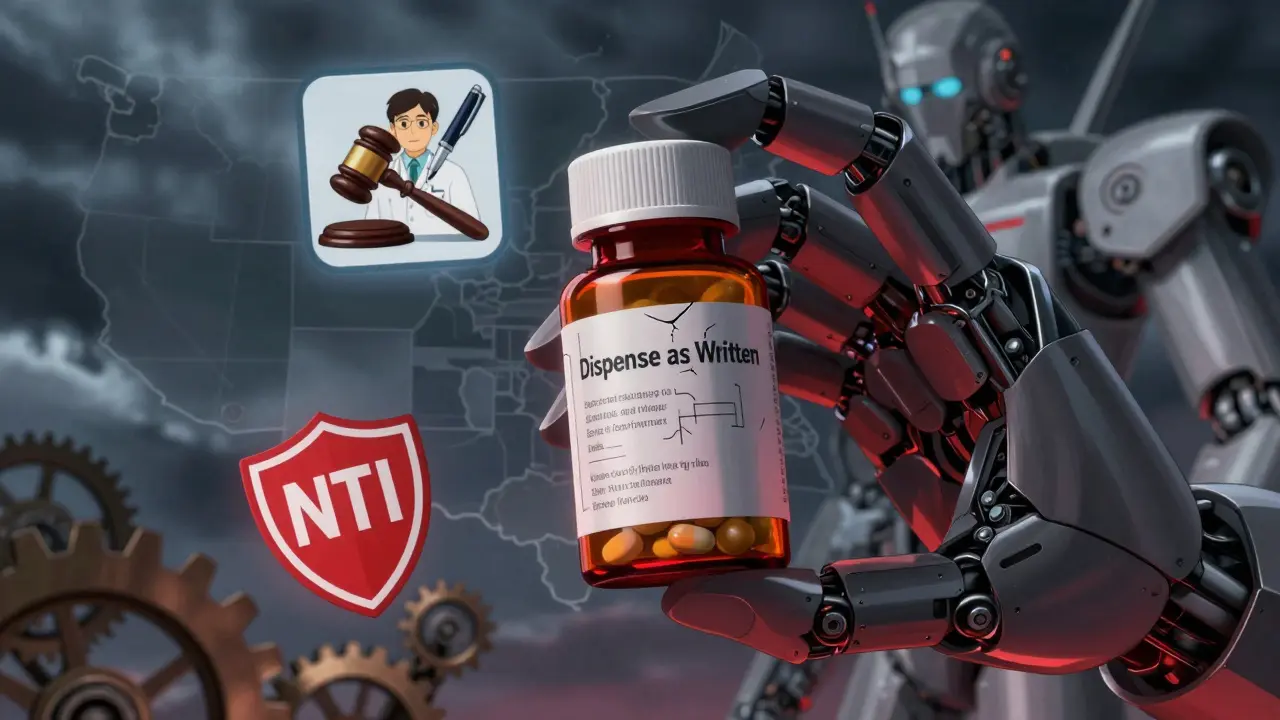
Third, your doctor can block substitution by writing “dispense as written” or “do not substitute” on the prescription. But here’s the twist: 18 states require the doctor to explain why they’re blocking it. That’s not just paperwork-it’s a barrier for patients who need the brand for stability reasons.
What Pharmacists Must Do (And What They Don’t)
Pharmacists are on the front lines. They’re expected to know 50 different sets of rules, track which drugs can’t be swapped, and document every substitution.
Forty-two states require pharmacists to record the substituted product in your file for at least two years. Fifteen states require them to inform you in person at the counter. But 24 states offer no legal protection if something goes wrong after substitution. That means a pharmacist could follow every state rule-and still get sued if you have a bad reaction.
And don’t assume “biosimilar” means “interchangeable.” The FDA treats them as different. A biosimilar is similar. An interchangeable one is proven to act exactly like the original. But in 2022, two-thirds of pharmacists said they were confused about the difference. If your pharmacist doesn’t know, you might be getting a drug they’re not legally allowed to swap.
How to Find Your State’s Rules
There’s no national database. But here’s how to get your state’s exact rules:
- Go to your state’s Board of Pharmacy website. Search for “drug product selection laws” or “generic substitution.”
- Check if your state uses a positive or negative formulary. A positive formulary lists approved generics you can swap. A negative formulary lists drugs that can’t be swapped-like NTI (narrow therapeutic index) drugs.
- Look for biosimilar rules. If you take a biologic, find out if your state requires notification, authorization, or cost matching.
- Use the Cardinal Health Interactive Map (2023 version). It shows which states require documentation, patient notification, and prescriber alerts.
For example: In Florida, pharmacists must notify both you and your doctor within 72 hours of swapping a biosimilar. In Alabama, they only need to log the swap in your record. That’s a huge difference.
What’s Changing in 2025 and Beyond
More biosimilars are getting “interchangeable” status. By 2030, they could make up 70% of the biologics market. But that won’t happen unless states simplify their rules.
California’s AB1881 (2023) strengthened patient notice requirements. New York’s S4472 expanded substitution rights. Meanwhile, the National Association of Boards of Pharmacy is pushing a model law that 22 states have started adopting. It’s pushing for consistent notification timelines and better documentation.
But until every state aligns, you’re stuck playing state-by-state roulette. Move from Texas to Oregon? Your pharmacist might suddenly stop swapping your meds. That’s not just inconvenient-it’s dangerous.
Practical Steps You Can Take Today
Don’t wait for the system to fix itself. Here’s what to do:
- Ask your pharmacist: “Is this a generic or biosimilar? Was it substituted?”
- Check your prescription label every time. If the name changed, ask why.
- Ask your doctor: “Can you write ‘dispense as written’ if I need the brand?”
- Keep a list of your meds and which ones you’ve been switched on.
- If you’re on a narrow therapeutic index drug (warfarin, lithium, levothyroxine), insist on staying on the same version.
Generic drugs save lives. But substitution isn’t just about cost-it’s about safety. And you deserve to know exactly what you’re taking.
Can my pharmacist substitute my brand-name drug without telling me?
In 24 states, pharmacists are not required to notify you before substituting a generic or biosimilar. In those states, you might not know you got a different drug unless you check the label. Always ask if substitution occurred, and never assume you were told.
What does “dispense as written” mean on my prescription?
“Dispense as written” means your doctor has blocked substitution. The pharmacist must give you the exact brand or generic listed on the script. In 18 states, the doctor must also provide a reason for this restriction-like patient history, allergy, or previous adverse reaction.
Are all biosimilars interchangeable with the original drug?
No. Only 10 out of 38 approved biosimilars have the FDA’s “interchangeable” designation. This means they’ve passed extra tests proving they can be swapped without added risk. Many biosimilars are similar but not interchangeable-and your state’s laws may still restrict substitution even if the drug is approved.
Can I be switched to a different generic every time I refill?
Yes. In states that allow substitution, pharmacies can switch between different generic manufacturers. One refill might be from Teva, the next from Mylan. This is legal, but if you’re on a narrow therapeutic index drug like warfarin, even small changes can affect your dose. Ask your pharmacist to stick with the same generic if possible.
Why do some states block substitution for certain drugs?
Drugs with a narrow therapeutic index (NTI)-like lithium, digoxin, and levothyroxine-have a tiny margin between effective and toxic doses. Even minor differences in how generics are made can cause side effects or reduce effectiveness. States like Kentucky and Hawaii maintain lists of NTI drugs that cannot be substituted without explicit approval.