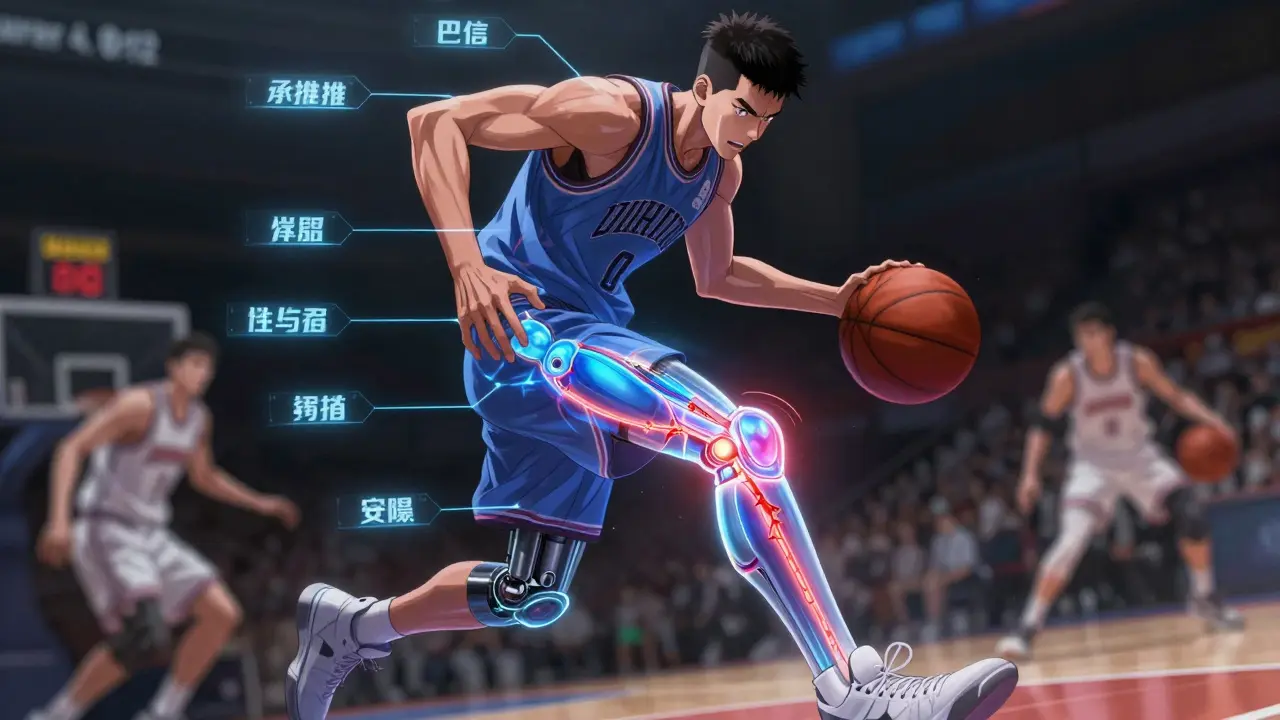
When a basketball player stops mid-dribble clutching their hip, or a soccer player can’t sprint without a deep ache in the groin, it’s often not a muscle strain. More and more, the culprit is a hip labral tear - a problem once overlooked but now recognized as one of the most common causes of chronic hip pain in athletes under 40.
What Exactly Is a Hip Labral Tear?
The labrum is a ring of tough cartilage that wraps around the socket of your hip joint, like a rubber seal on a jar. It helps hold the ball of the femur securely in place, deepens the socket, and cushions the joint. When this ring tears - whether from a single injury or years of repetitive stress - it can cause sharp pain, clicking, locking, or a feeling of instability in the hip. The most common cause? Femoroacetabular impingement (FAI). This isn’t a disease you catch - it’s a structural issue where the bones of the hip don’t fit together perfectly. One bone rubs against the other during movement, wearing down the labrum over time. It’s especially common in athletes who twist and turn quickly: soccer players, hockey forwards, ballet dancers, and even long-distance runners. Studies show that between 22% and 55% of athletic hip pain cases involve a labral tear. And if you’re under 40 and active, your risk goes up significantly. Left untreated, these tears don’t heal on their own. In fact, they can speed up the development of osteoarthritis - people with untreated labral tears are 4.5 times more likely to need a hip replacement within 10 years.How Do You Know It’s a Labral Tear?
Pain in the front of the hip or groin, especially during deep squats, sitting for long periods, or twisting, is the biggest red flag. But it’s easy to mistake for a pulled muscle or hip flexor strain. That’s why a proper diagnosis matters. Doctors start with a physical exam. Two tests are key: the FADIR test (flexion, adduction, internal rotation) and the FABER test (flexion, abduction, external rotation). If either triggers sharp pain or a clicking sensation, there’s a strong chance the labrum is involved. These tests are accurate in about 78% of confirmed cases. But physical exams alone aren’t enough. Imaging is critical.Imaging: From X-Rays to MRA
The first step is always plain X-rays. They don’t show soft tissue like the labrum, but they reveal bone shape - things like hip dysplasia (a shallow socket) or bone spurs from FAI. These structural problems are often the root cause of the tear. Standard MRI scans? Not reliable enough. They miss up to 30% of partial tears and only catch 35-60% of full tears. That’s why magnetic resonance arthrography (MRA) is now the gold standard for imaging. In MRA, contrast dye is injected into the hip joint before the scan. This makes the labrum stand out clearly. MRA detects labral tears with 90-95% accuracy - far better than regular MRI. The latest advance? 3D MRI sequencing. Introduced in 2023, this technique gives surgeons a detailed, rotating view of the joint before surgery. It’s now recommended by the International Hip Arthroscopy Society for complex cases, pushing diagnostic accuracy to 97%. Still, nothing beats direct visualization. That’s why hip arthroscopy remains the definitive diagnostic tool. When done by an experienced surgeon, it’s 98% accurate. And here’s the twist - during that same procedure, they can fix the tear.Treatment: Conservative vs. Surgery
Not everyone needs surgery. The first step is always conservative care: rest, anti-inflammatories like ibuprofen or naproxen, and avoiding movements that hurt. Many athletes try physical therapy next. But here’s the hard truth: only 30-40% of athletes get full relief with conservative treatment alone. Some clinics report higher success - up to 65% - but those are usually cases with mild tears and no underlying bone issues. Corticosteroid injections can help. They reduce inflammation and give 70-80% of patients relief for 3-6 months. That’s useful for getting through a season or delaying surgery. But it doesn’t fix the tear. If pain persists after 3-6 months, or if imaging shows a large tear with structural problems like FAI or hip dysplasia, surgery becomes the best option.
Arthroscopy: What Happens During Surgery?
Hip arthroscopy is minimally invasive. Surgeons make two or three tiny incisions, insert a small camera and instruments, and work inside the joint. Two main approaches:- Debridement: Trimming away the torn, frayed part of the labrum. This gives quick relief but doesn’t restore the labrum’s function.
- Repair: Sewing the labrum back to the bone using suture anchors. This is the preferred method when possible, especially in younger athletes.
Recovery and Return to Sport
Recovery isn’t fast. And it’s not the same for everyone.- Debridement: 3-4 months to return to sport
- Labral repair: 5-6 months
- Protection (weeks 1-6): No weight-bearing on the hip, gentle range-of-motion exercises.
- Strengthening (weeks 7-12): Focus on glutes, quads, and core. Achieving 90% strength symmetry between legs is a key milestone.
- Sport-specific training (weeks 13-20): Agility drills, controlled pivoting, jumping.
- Full return (weeks 21-26): Only when pain-free internal rotation reaches 30 degrees and strength is balanced.
Who Has the Best Outcomes?
Younger athletes (under 35) have the highest success rates - 85-90% return to pre-injury levels. For those over 35, that drops to 70-75%. Athletes in sports with extreme hip motion - hockey, ballet, gymnastics - face 25% higher complication rates. That’s because their joints are under constant high stress. Access to care matters too. Athletes treated at specialized sports medicine centers report 92% satisfaction. Those at general orthopedic clinics? Only 75%. Why? Because hip arthroscopy has a steep learning curve. Surgeons need 50-100 supervised cases to become proficient.
What About Regenerative Medicine?
PRP (platelet-rich plasma) injections are being studied as an alternative to surgery. One 2022 trial at Hospital for Special Surgery found 55% of patients avoided surgery after 12 months. But results vary. It’s not a cure-all - and it’s rarely covered by insurance.Complications and Risks
Most surgeries go well. But complications happen:- Persistent pain: 15-20% of cases
- Heterotopic ossification (bone growing where it shouldn’t): 5-10%
- Nerve injury: 1-2%
- Revision surgery within 5 years: 8-12%
Why This Matters Now
Hip arthroscopy has exploded in popularity. Over 150,000 were done in the U.S. in 2022 - triple the number in 2010. The global market hit $1.2 billion in 2022 and is growing over 12% per year. Basketball, soccer, hockey, and running account for 65% of all diagnoses. And with better imaging and surgical techniques, more athletes are getting back to play - but only if they get the right diagnosis and treatment. The message is clear: don’t ignore hip pain in athletes. It’s not just a strain. It could be a labral tear - and if left untreated, it could end your career or lead to early arthritis. Get imaging. Rule out structural issues. And if surgery is needed, find a surgeon who specializes in hip arthroscopy - not just any orthopedist.Can a hip labral tear heal on its own?
No. The labrum has poor blood supply, so it doesn’t heal naturally. While some people manage pain with rest and therapy, the tear itself won’t repair. Without addressing the underlying cause - like FAI or dysplasia - the tear often worsens over time.
Is MRA better than regular MRI for diagnosing labral tears?
Yes. MRA (magnetic resonance arthrography) is far more accurate. Standard MRI misses up to 30% of partial tears and only detects 35-60% of full tears. MRA uses contrast dye injected into the joint, making the labrum visible with 90-95% accuracy. It’s the recommended first-line imaging test for suspected labral tears in athletes.
How long does recovery take after hip arthroscopy?
Recovery depends on the procedure. For labral debridement, most athletes return to sport in 3-4 months. For labral repair, it takes 5-6 months. Full recovery requires structured physical therapy, with milestones like 90% quadriceps strength symmetry and pain-free internal rotation before returning to high-impact sports.
Do I need surgery if I have a labral tear?
Not always. If the tear is small and you respond to rest, anti-inflammatories, and physical therapy, surgery may not be needed. But if you have structural issues like FAI or hip dysplasia, or if pain persists after 3-6 months of conservative care, surgery is usually the best option to prevent long-term joint damage.
Can hip labral tears lead to arthritis?
Yes. Untreated labral tears increase the risk of osteoarthritis by 4.5 times within 10 years. The torn labrum no longer protects the joint properly, leading to abnormal wear on the cartilage. Early diagnosis and treatment - especially fixing underlying bone issues - can significantly delay or even prevent arthritis.