
The 30-month stay isn’t just a legal footnote-it’s a major roadblock standing between patients and affordable generic drugs. Since 1984, this rule has quietly shaped how much Americans pay for prescriptions. When a brand-name drug company holds a patent, and a generic manufacturer dares to challenge it, the 30-month stay kicks in. And for many drugs, that means months-sometimes years-of delays before the cheaper version hits shelves.
What Exactly Is the 30-Month Stay?
The 30-month stay comes from the Hatch-Waxman Act, a law passed to balance two goals: letting generics enter the market quickly while protecting innovators’ patents. Here’s how it works in practice. A generic company files an application with the FDA to sell a copy of a brand drug. But instead of saying their drug doesn’t infringe any patents, they file what’s called a Paragraph IV certification. That’s a legal challenge: “Your patent is invalid or we don’t infringe it.”
Once that notice is sent, the brand company has 45 days to sue. If they do, the FDA is legally blocked from giving final approval to the generic drug for up to 30 months. That’s the stay. It doesn’t stop the FDA from reviewing the application. In fact, they often give tentative approval during this time. But the drug can’t be sold until the stay ends-either because the court rules in favor of the generic, the patent expires, or the 30 months run out.
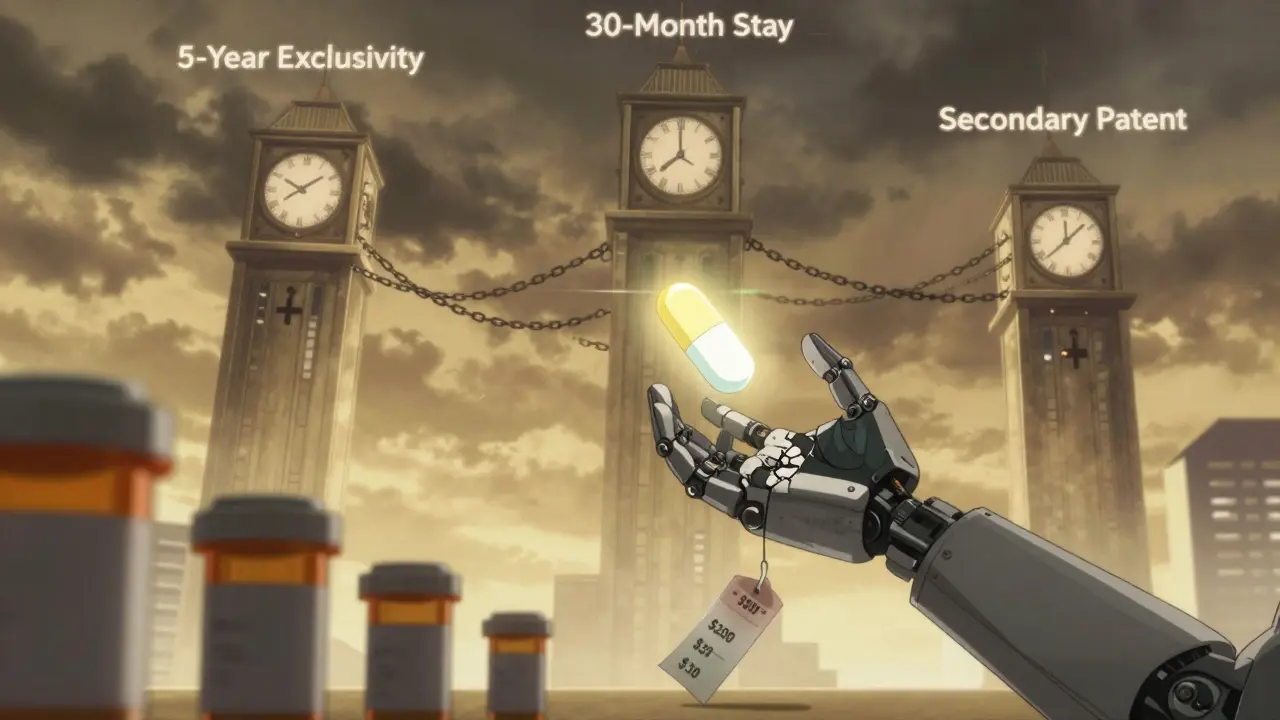
And here’s the kicker: the 30 months isn’t always the end. Courts can extend it if litigation drags on. Or, if the brand drug has its own five-year exclusivity period (for new chemical entities), the total delay can stretch to nearly 40 months. That’s more than three years of blocked competition.
Why This Matters for Patients and Prices
Generic drugs are cheaper because they don’t have to repeat expensive clinical trials. They just prove they’re the same as the brand drug. That’s why generics make up 90% of prescriptions in the U.S. but only 23% of total drug spending. When a generic launches, prices drop by 80% to 85% within a year. But the 30-month stay often pushes that moment farther away.
Take a drug like Lipitor. When its patent expired, multiple generics rushed in. Prices plummeted. But for many other drugs, that moment never comes-or comes much later. According to FDA data from 2022, 78% of ANDAs (generic applications) received tentative approval while litigation was ongoing. Yet the average time between tentative approval and final launch was 11.3 months. Why? Because the delay isn’t always the legal stay-it’s the brand company’s strategy.
Patent Evergreening and the Real Game
Brand companies don’t just rely on one patent. They build patent thickets. A drug might have dozens of patents covering everything from the chemical structure to the pill coating to the way it’s taken. The 30-month stay only applies once per ANDA, thanks to the 2003 MMA law. But here’s the loophole: companies file new patents on minor changes-like a new dosage form or a different release mechanism-and then sue again.
A 2019 Brookings study found that 67% of patents listed in the FDA’s Orange Book for top-selling drugs were filed after the original drug approval. That’s not innovation-it’s extension. And each new patent can trigger a new legal battle, even if the original 30-month stay has expired. This tactic, called “patent evergreening,” keeps generics out longer than the original patent should allow.
It’s not theoretical. A 2021 study from USC and the University of Michigan found that for blockbuster drugs, the 30-month stay added an average of 1.8 years to market exclusivity. That’s not just delay-it’s billions in extra profits for brand companies.

Who Pays the Price?
The cost isn’t just financial. It’s personal. When a generic is delayed, patients either pay full price or go without. The FTC estimates that delays caused by the 30-month stay and related litigation add $13.9 billion annually to U.S. drug spending. That’s money taken from families, Medicare, and insurers.
Generic manufacturers aren’t immune either. A 2022 survey by the Association for Accessible Medicines found that 63% of generic companies spend $3-5 million per ANDA on legal fees alone. And 78% said preparing for litigation adds 6-9 months to their development timeline. That’s money and time that could’ve gone into developing new generics.
Meanwhile, brand companies defend the system. Former FDA Commissioner Scott Gottlieb says it’s kept innovation alive, saving consumers $2.2 trillion since 1984. But critics point out: that $2.2 trillion saved is from generics that did get through. The real cost is in the ones that never made it-or came too late.
How the System Is Changing
Pressure is building. In 2023, Congress introduced the Affordable Prescriptions for Patients Act, which would cut the 30-month stay to 18 months and block stays for secondary patents. The FTC is pushing for stricter rules on Orange Book listings, where brand companies currently list an average of 8.3 patents per drug-up from 1.2 in 1995.
The FDA itself is moving too. Its 2023 draft guidance asks for more transparency in patent filings, which could stop companies from gaming the system with vague or overlapping patents. And if these reforms pass, analysts predict they could accelerate generic entry for $78 billion worth of drugs set to lose patent protection by 2028-potentially saving consumers $195 billion.
But change won’t come easy. PhRMA, the drug industry lobby, warns that weakening the stay could slash R&D investment by $14 billion a year. That’s a real concern. Innovation needs protection. But when protection becomes a tool for delay, the system breaks.
The Bigger Picture: Biologics and the Future
Here’s something most people don’t realize: the 30-month stay doesn’t apply to biologics. Those are complex drugs made from living cells-like insulin or cancer treatments. They get 12 years of exclusivity under a different law (BPCIA), with no litigation-triggered stay. That’s why biosimilars (the biologic version of generics) are growing fast. By 2028, they’re expected to make up 12% of the biologics market.
That’s a clue. The 30-month stay was built for simple chemical drugs. It’s not designed for today’s complex market. And as more drugs become biologics or combination therapies, the Hatch-Waxman system looks increasingly outdated.
What’s Next?
The 30-month stay isn’t going away. But it’s under fire. Whether it shrinks, gets reformed, or gets replaced, one thing is clear: the current system is not working as intended. It was meant to balance innovation and access. Today, it often tips too far toward delay.
Patients don’t need to understand patent law. They just need affordable medicine. And right now, the law is standing in their way-not helping it.