
Renal Artery Stenosis Risk Estimator
Patient Profile Configuration
Select the conditions that apply to the patient scenario.
Assessment Result
Calculating...Physiological Explanation:
Configure Patient Profile
Select options on the left and click "Calculate Risk" to see how ACE inhibitors affect kidney hemodynamics in different scenarios.
You take your blood pressure pill every morning. It’s an ACE inhibitor, a standard, trusted medication for millions of people with hypertension or heart failure. But if you have Renal Artery Stenosis, specifically affecting both kidneys or your only functioning kidney, that same pill could trigger sudden, severe kidney failure. This isn’t a rare side effect; it is a well-documented physiological trap that has been known since the early 1980s. Yet, despite clear guidelines, patients are still prescribed these drugs without adequate screening, leading to preventable hospitalizations.
Understanding why this happens requires looking past the label and into the mechanics of your kidneys. It’s not just about "kidney damage" in a vague sense. It is a precise hemodynamic collapse caused by blocking a specific survival mechanism your body uses when blood flow is restricted. Here is exactly what goes wrong, who is at risk, and how doctors should-and often do-miss the warning signs.
The Physiology: How Your Kidneys Survive Low Blood Flow
To understand the danger, you first need to understand how a healthy kidney handles low pressure. Under normal conditions, blood flows freely through the renal arteries into the glomerulus, the filtering unit of the kidney. The filtration rate depends on the pressure inside these tiny capillaries.
When one or both renal arteries narrow-a condition called Renal Artery Stenosis-blood pressure drops before it reaches the kidney. The kidney senses this drop via specialized cells in the afferent arterioles (the vessels bringing blood in). These cells release renin, which kicks off a cascade resulting in the production of Angiotensin II.
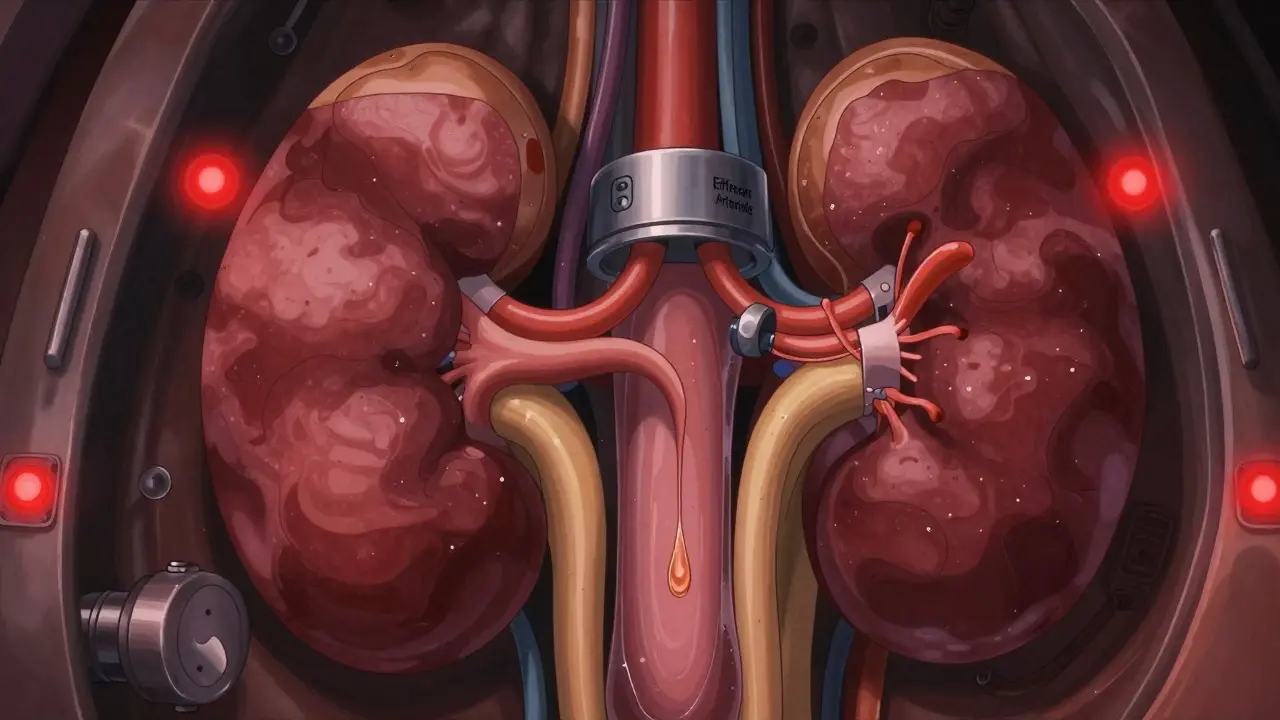
Angiotensin II is a potent vasoconstrictor. In a healthy person, it raises systemic blood pressure. But in a kidney with narrowed arteries, it does something more local and critical: it constricts the efferent arteriole (the vessel taking blood out of the filter). Think of it like putting your thumb over the end of a garden hose. By narrowing the exit, pressure builds up inside the hose, maintaining flow even if the water source is weak.
In renal artery stenosis, Angiotensin II increases resistance at the efferent arteriole by approximately 37.5% compared to non-stenotic kidneys. This maintains high intraglomerular pressure, allowing the kidney to continue filtering waste despite poor incoming blood flow. It is a life-saving adaptation.
The Mechanism: Why ACE Inhibitors Break the System
ACE Inhibitors (Angiotensin-Converting Enzyme inhibitors) work by blocking the conversion of Angiotensin I to Angiotensin II. Drugs like lisinopril, enalapril, and ramipril are designed to lower blood pressure by relaxing blood vessels throughout the body. They are excellent for this job in most patients.
However, in a patient with bilateral renal artery stenosis (narrowing in both kidneys) or unilateral stenosis in a solitary kidney, removing Angiotensin II removes the "thumb on the hose." Without Angiotensin II, the efferent arteriole dilates (opens up). The resistance drops. The intraglomerular pressure plummets by 25-30%. Suddenly, the filtration pressure is too low to push fluid through the membrane. Glomerular Filtration Rate (GFR) crashes.
This isn't gradual scarring; it's an acute functional shutdown. Clinically, this manifests as a rapid rise in serum creatinine. Studies show that within 7 to 10 days of starting an ACE inhibitor, patients with undiagnosed bilateral stenosis can see their creatinine levels jump by more than 30%. If left unchecked, this leads to acute kidney injury (AKI), requiring dialysis in severe cases.
| Patient Profile | Efferent Arteriole Response | Intraglomerular Pressure | Change in Serum Creatinine | Risk Level |
|---|---|---|---|---|
| Healthy Kidneys | Mild dilation | Slight decrease | <10-15% | Low |
| Unilateral Stenosis (Normal Contralateral Kidney) | Dilation in affected kidney | Decrease in affected kidney, compensated by healthy kidney | Minimal (<10%) | Low/Moderate |
| Bilateral Stenosis OR Solitary Kidney with Stenosis | Significant dilation | Sharp drop (25-30%) | >30% increase | High (Contraindicated) |
Who Is Actually at Risk? Defining the Contraindication
The term "contraindication" is often used loosely, but in this context, it is specific. ACE inhibitors are absolutely contraindicated in two scenarios:
- Bilateral Renal Artery Stenosis: Narrowing of the arteries supplying both kidneys.
- Unilateral Stenosis in a Solitary Kidney: You have only one kidney, and its artery is narrowed.
If you have narrowing in only one artery but a perfectly healthy second kidney, the situation is different. The healthy kidney compensates for the loss of function in the affected side. Research from the ASTRAL trial follow-up analysis showed no significant difference in estimated GFR decline between ACE inhibitor users and non-users in patients with unilateral stenosis. In these cases, doctors may cautiously prescribe ACE inhibitors because the cardiovascular benefits often outweigh the minimal renal risk.
However, distinguishing between unilateral and bilateral disease before prescribing is the critical step that is frequently missed. Approximately 6.8% of patients with hypertension and existing renal impairment have significant renal artery stenosis. That is nearly 1 in 15 patients who might be walking into a physiological trap.
Screening and Diagnosis: Catching It Before It Fails
So, how do we know who has this stenosis? We don't scan every hypertensive patient-that would be cost-prohibitive and unnecessary. Instead, clinicians look for "red flags" that suggest renovascular hypertension. According to the 2021 European Society of Cardiology guidelines, you should suspect renal artery stenosis if a patient presents with:
- Accelerated or Resistant Hypertension: High blood pressure that is difficult to control with three or more medications.
- Unexplained Renal Impairment: A sudden or unexplained rise in creatinine without other obvious causes.
- Abdominal Bruits: A "whooshing" sound heard through a stethoscope over the abdomen, indicating turbulent blood flow through narrowed arteries.
- Flash Pulmonary Edema: Sudden onset of fluid in the lungs, often linked to stiff, ischemic kidneys failing to handle sodium load.
If any of these signs are present, the gold standard for initial screening is a Renal Artery Duplex Ultrasound. This non-invasive test has a sensitivity of 86% and specificity of 92% for detecting hemodynamically significant stenosis. It measures blood flow velocity directly. If the ultrasound is inconclusive or suggests surgery, a CT angiogram or MR angiogram may follow.
Despite these tools, a 2020 study published in the *Journal of General Internal Medicine* found that 22.4% of patients with *known* bilateral renal artery stenosis were still prescribed ACE inhibitors in primary care settings. This highlights a dangerous gap in clinical awareness and record-keeping.
Monitoring Protocols: The 10-Day Rule
Even with screening, some cases slip through. That is why monitoring is non-negotiable. The National Institute for Health and Care Excellence (NICE) guidelines provide a clear protocol that every prescriber should follow:
- Baseline Check: Measure serum creatinine and potassium before starting the ACE inhibitor.
- The 10-Day Window: Repeat blood tests approximately 10 days after starting the drug or increasing the dose.
- The Threshold: If serum creatinine rises by more than 30% from baseline, stop the drug immediately and investigate for renal artery stenosis.
- Specialist Supervision: If baseline creatinine exceeds 150 micromol/L, ACE inhibitors should only be introduced under specialist supervision.
Why 10 days? Because the hemodynamic changes happen quickly, but the biochemical markers take a few days to stabilize and reflect the new steady state. Checking too early might miss the peak effect; checking too late risks permanent damage. The deterioration is usually reversible if caught within 72 hours of the onset of hypoperfusion. Beyond that, acute tubular necrosis can set in, causing permanent scarring.

What About ARBs? Are They Safer?
A common question from patients is: "If ACE inhibitors hurt my kidneys, can I switch to an Angiotensin Receptor Blocker (ARB) like losartan or valsartan?"
The short answer is no. Not for this specific condition. While ARBs work differently-they block the receptor rather than the enzyme-they achieve the same physiological result: reduced Angiotensin II activity. Consequently, they also cause efferent arteriolar dilation. The 2019 KDIGO Clinical Practice Guideline explicitly lists bilateral renal artery stenosis as a contraindication for both ACE inhibitors and ARBs. Switching from one to the other offers no protection against acute kidney injury in this context.
Alternatives for Managing Blood Pressure
If a patient has bilateral renal artery stenosis, they still need blood pressure control to protect their heart and brain. What are the options? Doctors typically turn to medications that do not rely on the renin-angiotensin system for their primary effect on renal hemodynamics:
- Calcium Channel Blockers (CCBs): Drugs like amlodipine relax vascular smooth muscle but primarily affect the afferent arteriole (the inlet), which helps maintain perfusion pressure without collapsing the filtration gradient as drastically as ACEIs.
- Diuretics: Thiazides or loop diuretics help manage volume overload, though they must be used carefully if kidney function is already compromised.
- Revascularization: In select cases, particularly those with flash pulmonary edema or progressive kidney failure, placing a stent in the renal artery (angioplasty) can restore blood flow. However, recent trials like CORAL have shown mixed results for routine stenting, so it is reserved for symptomatic or refractory cases.
How quickly does kidney failure occur after starting an ACE inhibitor?
Symptoms of acute kidney injury can develop within 7 to 10 days of initiating therapy. A rise in serum creatinine of greater than 30% is the key warning sign. If untreated, permanent damage can begin after 72 hours of sustained hypoperfusion.
Can I take an ACE inhibitor if I have only one kidney?
It depends on the health of that single kidney. If you have a solitary kidney with a normal renal artery, ACE inhibitors are generally safe and beneficial. However, if your solitary kidney has renal artery stenosis, ACE inhibitors are strictly contraindicated because there is no second kidney to compensate for the drop in filtration.
What are the symptoms of renal artery stenosis?
Many people have no symptoms until complications arise. Warning signs include resistant high blood pressure, abdominal pain after eating (intestinal angina), a whooshing sound (bruit) in the abdomen, and sudden swelling in the legs or lungs (pulmonary edema).
Is the kidney damage from ACE inhibitors reversible?
Yes, in most cases, if the drug is stopped promptly upon detecting a significant rise in creatinine. The functional shutdown is hemodynamic, not structural. However, if the kidney is starved of oxygen for too long (typically beyond 72 hours), permanent tissue death (necrosis) can occur.
Should everyone get an ultrasound before taking Lisinopril?
No, universal screening is not recommended due to cost and low prevalence in the general population. Screening is reserved for high-risk patients: those with severe/resistant hypertension, unexplained kidney dysfunction, abdominal bruits, or a history of vascular disease elsewhere (like carotid or leg arteries).