
When your tendon hurts-not just a quick twinge, but a deep, persistent ache that lingers after running, jumping, or even walking-you’re not just dealing with inflammation. You’re dealing with tendinopathy. It’s not a sprain. It’s not a tear. It’s a breakdown. And the old advice-rest, ice, and wait-doesn’t fix it. What does? Two things: the right kind of loading and knowing when injections might help-or hurt.
What Tendinopathy Really Is (And Why Rest Doesn’t Work)
Tendinopathy isn’t inflammation. That’s the biggest myth. Ten years ago, doctors called it “tendonitis.” Now we know: there’s little to no inflammation in chronic cases. Instead, the tendon’s collagen fibers get disorganized, weak, and thickened. It’s like a frayed rope trying to hold up a heavy load. The pain comes from nerve sensitivity in the damaged tissue, not swelling.
This is why resting it for weeks doesn’t help. Tendons need load to heal. Too little, and they get weaker. Too much, and they break down further. The trick is finding the sweet spot: enough stress to trigger repair, but not so much it crashes your pain levels.
Eccentric Training: The Gold Standard (And Why It Hurts)
If you’ve heard one thing about tendinopathy, it’s probably this: do eccentric exercises. And you’re right. For Achilles and patellar tendinopathy, eccentric training is the most proven, evidence-backed treatment out there.
What’s eccentric? It’s the lowering phase. Think of a bicep curl: lifting the weight is concentric. Letting it down slowly is eccentric. For tendons, that slow, controlled descent is what rebuilds the tissue.
For Achilles tendinopathy, the classic Alfredson protocol is still the benchmark: stand on a step, raise up on both feet, then drop the heel of the injured foot down slowly over 3-5 seconds. Do 3 sets of 15 reps, twice a day. Do it with your knee straight (targets gastrocnemius) and bent (targets soleus). You’ll feel it. A lot. That’s normal.
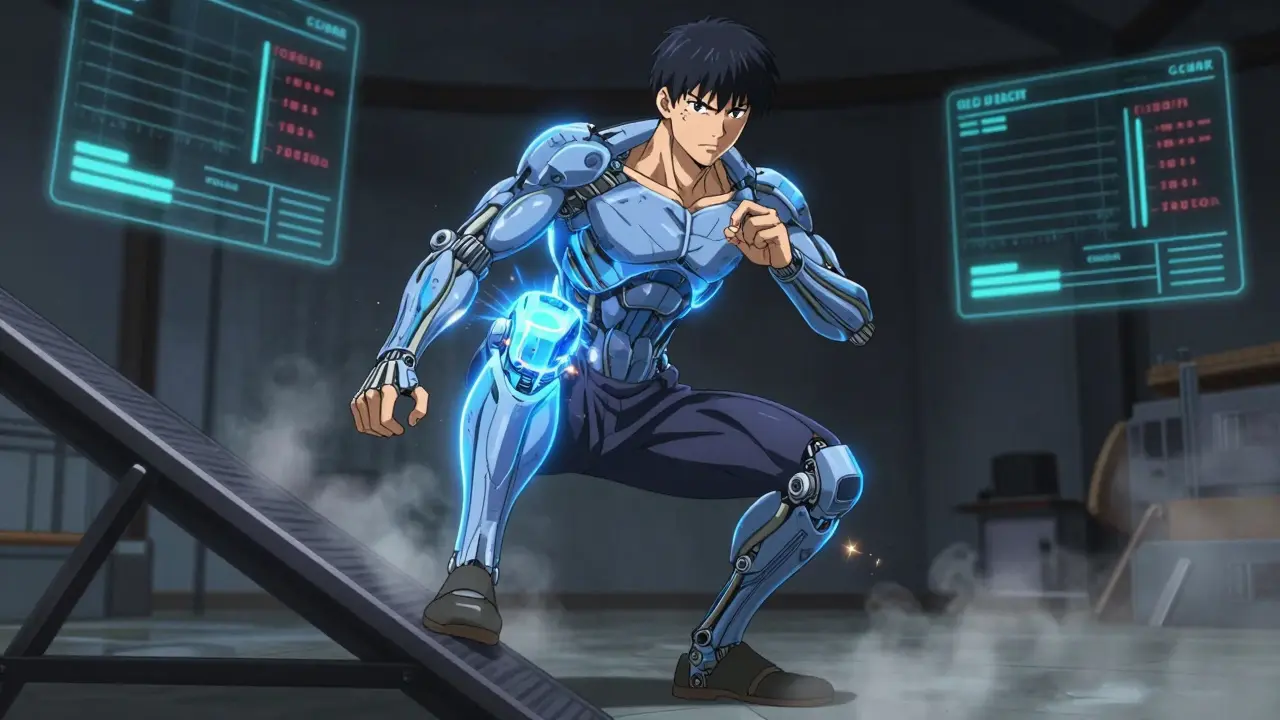
For patellar tendinopathy (jumper’s knee), the go-to is the single-leg decline squat. Stand on a 25-degree ramp, lower yourself slowly over 3-5 seconds, then use both legs to stand back up. Three sets of 15, daily. It’s brutal at first. Your knee will scream. But that’s the signal your tendon needs.
Studies show these protocols improve pain and function by 40-65% after 12 weeks. The Victorian Institute of Sports Assessment (VISA) scores-used to measure tendon health-jump from around 40 to 80+ in responders. That’s the difference between limping and running again.
Heavy Slow Resistance: The Quiet Contender
But here’s the twist: eccentric training isn’t the only way. Heavy slow resistance (HSR) training-lifting weights slowly with controlled movements-works just as well for many people, and sometimes better.
Instead of just lowering, HSR includes both the lifting and lowering phases, done slowly (3 seconds up, 3 seconds down), using 70% of your one-rep max. Three times a week. For Achilles tendinopathy, a 2015 study found HSR and eccentric training led to identical improvements in VISA-A scores. But here’s the kicker: 87% of people stuck with HSR. Only 72% stuck with eccentric.
Why? Less initial pain. HSR feels more like strength training. Eccentric training feels like punishment. If you’re the kind of person who dreads pain, HSR might be your better bet. And it’s easier to scale. You can add weight. You can track progress. You can feel strong while healing.
Isometrics: The Instant Pain Relief Trick
What if you need to play soccer tomorrow but your tendon is screaming today? Isometrics can help.
Isometric holds are when you contract the muscle without moving the joint. For Achilles, stand on your toes and hold the position for 45 seconds. Do three sets, three times a day. For patellar, sit with your knee bent at 60 degrees and press your foot into the floor, squeezing your quad hard for 45 seconds. Three sets.
A 2015 study showed this reduces pain by 50% within 45 minutes. That’s not a placebo. It’s a neurological reset. It tells your nervous system: “This load is safe.” It doesn’t fix the tendon-but it lets you move. Use it before activity. Use it when pain flares. It’s your emergency tool.
Injections: What Works, What Doesn’t
When exercise isn’t enough, injections come up. But not all injections are created equal.
Corticosteroid injections are common. They give quick relief-30-50% less pain in 2-4 weeks. But here’s the catch: they increase your risk of tendon rupture by 2-3 times. And at six months? People who got shots are 65% more likely to need more treatment than those who stuck with exercise. They mask the problem. They don’t fix it. Use them sparingly, if at all.
Platelet-rich plasma (PRP) sounds fancy. You take your own blood, spin it to concentrate the platelets, and inject it into the tendon. The theory? Growth factors = healing. But the data? Disappointing. A 2020 review found PRP only beat placebo by 15-20% at six months. Not enough to justify the cost ($500-$1,000 per shot) or the discomfort.
What about ultrasound-guided dry needling or sclerosing injections? They help some people with chronic, painful tendons, especially when there’s abnormal blood vessel growth. But they’re not first-line. They’re for stubborn cases after rehab fails.
Bottom line: injections should be a backup. Not a shortcut. The best outcome? Combine them with exercise. Inject to reduce pain, then train to rebuild strength.
Why People Fail at Eccentric Training
Most people don’t quit because it doesn’t work. They quit because it hurts too much at first-and they don’t know how to manage it.
68% of patients report unbearable pain in the first two weeks. That’s normal. But if your pain hits 7/10 or lasts longer than 24 hours after exercise? You’re overdoing it. The goal isn’t “no pain.” It’s “acceptable pain”-2 to 5/10 during and after. That’s the healing zone.
Another big mistake? Doing it wrong. A 2021 study found self-taught patients made errors in form 40% of the time. They rush the eccentric phase. They don’t use the right angle. They skip the knee-bent variation. That’s why working with a physical therapist-even just twice-is worth it. Correct form doubles your success rate.
And adherence? Huge. People using the Tendon Rehab app (with video feedback and reminders) stuck with it 85% of the time. Those using paper handouts? Only 65%. Technology helps. Tracking progress helps. Having a plan helps.
The Bigger Picture: Load Management and Individualization
Here’s what most guides don’t tell you: not everyone responds to eccentric training. About 30% of patients don’t improve, even after 12 weeks. Why? Because tendinopathy isn’t one-size-fits-all.
Dr. Jill Cook’s tendon continuum model explains it: your tendon could be in reactive mode (acute overload), disrepair (early degeneration), or degenerative (long-term damage). Each needs a different approach. Reactive? Start with isometrics. Degenerative? Focus on heavy strength. One protocol doesn’t fit all.
Also, your overall load matters. If you’re running 40 miles a week with weak glutes and tight calves, no amount of heel drops will fix it. You need to manage your total load. Cut back on high-impact activity. Strengthen your hips. Improve your mobility. Tendons don’t heal in isolation.
What to Do Next: A Simple Action Plan
If you have tendinopathy, here’s your roadmap:
- Get a proper diagnosis. Not just “it hurts.” Confirm it’s tendinopathy, not a tear or nerve issue.
- Start with isometrics for immediate pain relief. Do 3 sets of 45-second holds, twice a day.
- Choose your loading protocol: eccentric for Achilles/patellar, HSR if you prefer strength-based training.
- Work with a physical therapist for the first 1-2 sessions to nail your form.
- Use an app like Tendon Rehab to track reps, pain levels, and progress.
- Keep pain between 2-5/10 during exercise. Stop if it hits 7/10 or lingers past 24 hours.
- Stick with it for at least 12 weeks. Don’t quit at 4 weeks. Tendons take time.
- If no progress after 12 weeks? Reassess. Consider PRP or dry needling-but only as a supplement to exercise.
Most people who stick with this get back to their sport, their job, their life. It’s not fast. But it’s real. And it lasts.