
Immunosuppressive Therapy Monitor
Patient Data Entry
Analysis Report
Enter your lab values to check against standard therapeutic windows.
Imagine walking a tightrope where falling left means your body attacks the new organ you’re relying on, and falling right means the drugs saving that organ start destroying your kidneys or leaving you open to deadly infections. This is the daily reality for anyone on immunosuppressive therapy, which is a medical treatment using drugs to suppress the immune system to prevent organ rejection or manage autoimmune diseases. Whether you are a kidney transplant recipient or someone managing severe lupus or rheumatoid arthritis, the margin for error is razor-thin. You cannot just take these pills and hope for the best; you need precise, ongoing surveillance.
The goal isn’t just to keep you alive-it’s to keep you thriving without constant hospital visits. Effective monitoring reduces acute rejection rates by 37% and improves five-year graft survival by 22%, according to data from the American Society of Transplantation. But how do doctors know if the balance is right? They rely on a combination of blood tests, imaging, and increasingly, advanced biomarkers. Here is exactly what you need to look out for in your lab results and scans.
Therapeutic Drug Monitoring: The Core Metric
Not all immunosuppressants require the same level of scrutiny. While corticosteroids like prednisone generally don’t need routine blood level checks, other powerful drugs have a narrow "therapeutic window." This means the difference between a dose that works and a dose that causes toxicity is often just two to four times smaller. Because every person metabolizes these drugs differently-some people might need half the dose of their neighbor to achieve the same effect-Therapeutic Drug Monitoring (TDM) is the practice of measuring specific drug concentrations in the blood to ensure they remain within a safe and effective range.
The most critical drugs requiring TDM include calcineurin inhibitors like tacrolimus and cyclosporine, as well as mTOR inhibitors like sirolimus. For kidney transplant patients, target ranges for tacrolimus are typically 5-10 ng/mL during the first three months post-transplant, dropping to 3-7 ng/mL afterward. Cyclosporine targets are higher, usually between 100-200 ng/mL. If your levels dip below these ranges, your risk of rejection skyrockets. If they spike above, you risk kidney damage and neurotoxicity.
How these levels are measured matters too. Most hospitals use immunoassays because they are cheaper ($50-$100 per test), but they can cross-react with drug metabolites, leading to inaccurate readings up to 20% of the time. The gold standard is liquid chromatography-tandem mass spectrometry (LC-MS/MS). It costs more ($150-$250) but offers 95-98% precision. If your numbers seem erratic despite consistent dosing, ask your doctor if LC-MS/MS testing is available at your lab.
Routine Laboratory Surveillance: What Your Blood Tells You
Beyond checking drug levels, your immune system’s suppression shows up in routine blood work. These tests monitor for side effects that often creep up silently. You should expect regular panels checking your full blood count, kidney function (creatinine and urea), liver enzymes, electrolytes, and fasting glucose.
- Kidney Function: Both tacrolimus and cyclosporine are nephrotoxic. A serum creatinine increase of more than 30% from your baseline is a red flag. This happens in about 25% of patients on cyclosporine. Early detection allows doctors to adjust doses before permanent damage occurs.
- Blood Counts: Drugs like mycophenolate and sirolimus can suppress bone marrow. Leukopenia (low white blood cells) affects 25-30% of mycophenolate users, while anemia impacts 20-25%. Regular complete blood counts (CBCs) catch this early.
- Metabolic Health: Sirolimus is notorious for causing hyperlipidemia, affecting 60-75% of patients. Fasting lipid profiles every six months are non-negotiable. Tacrolimus also carries a 30% higher incidence of diabetes compared to cyclosporine, making fasting glucose checks essential.
- Electrolytes: Hypomagnesemia (low magnesium) occurs in 40-60% of patients on cyclosporine. Symptoms like muscle cramps or tremors shouldn’t be ignored-they often signal an electrolyte imbalance rather than a neurological issue.
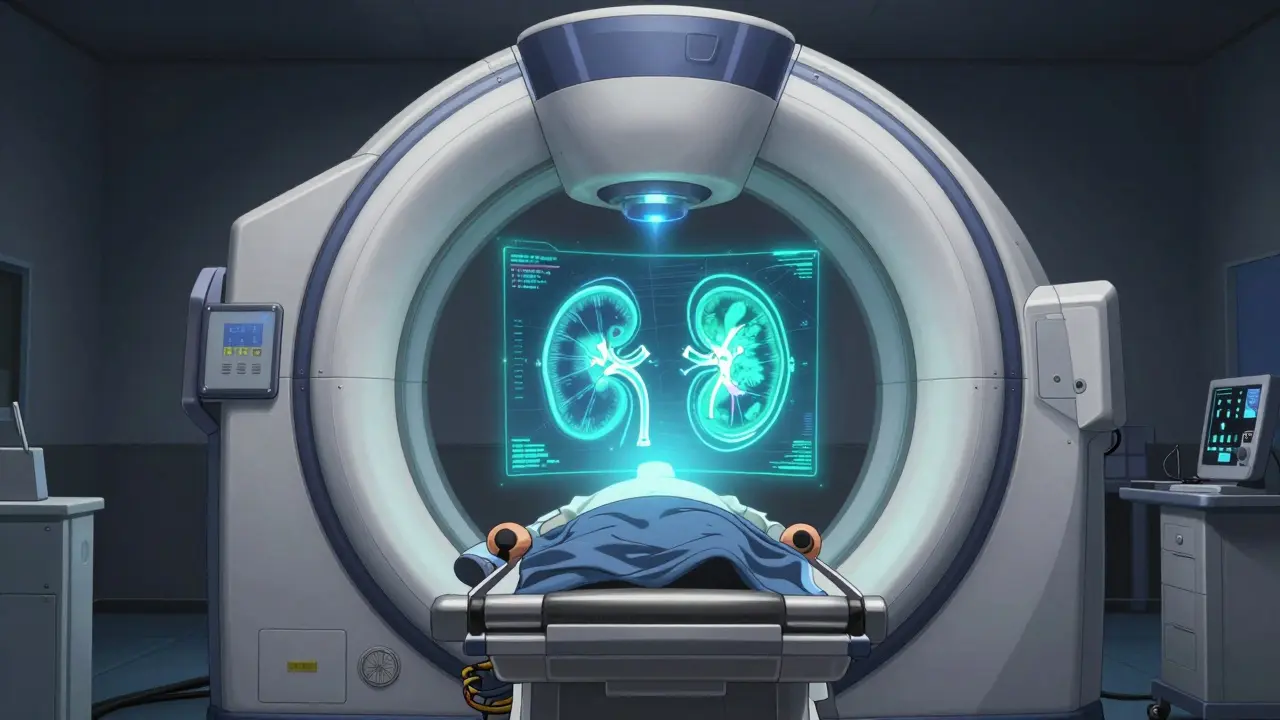
Imaging Modalities: Seeing Beyond the Blood
Blood tests give you numbers, but imaging gives you context. Depending on your medication regimen and history, you may need periodic scans to rule out structural issues or early signs of disease.
| Imaging Type | Frequency | Purpose / Target Condition |
|---|---|---|
| Renal Ultrasound | Annually or if renal function changes | Detects obstruction, cysts, or structural changes in the transplanted kidney. |
| Chest X-ray | As needed (suspected symptoms) | Screens for pneumonitis (especially with sirolimus); sensitivity is 70-85%. |
| DEXA Scan | Annually after 1 year of steroid use | Monitors bone density for osteoporosis risk caused by long-term corticosteroid therapy. |
If you are on sirolimus, pay close attention to any persistent cough or shortness of breath. Sirolimus-induced pneumonitis occurs in 1-5% of patients. A chest X-ray is the first line of defense here. Similarly, if you’ve been on steroids for over a year, annual DEXA scans are crucial. Steroids leach calcium from bones, and osteoporosis doesn’t hurt until a fracture happens. Prevention is far easier than repair.
The New Frontier: Torque Teno Virus (TTV) as an Immunometer
Traditional monitoring has a blind spot: it measures drug concentration, not immune function. Two people can have identical tacrolimus levels, but one might be over-immunosuppressed (prone to infection) while the other is under-immunosuppressed (prone to rejection). Enter Torque Teno Virus (TTV), which is a common human virus used as a surrogate marker to measure the overall strength of a patient's immune system.
TTV is present in nearly everyone. When your immune system is suppressed, TTV replicates freely. When your immune system is strong, it keeps TTV in check. Studies show a direct correlation (r=0.78) between TTV viral load and immunosuppressive drug levels. The sweet spot for kidney transplant recipients in months 4-12 is a plasma load of 2.5-3.5 log10 copies/mL.
- Low TTV (<2.5 log10): Indicates a robust immune response, increasing the risk of acute rejection (Hazard Ratio 3.2).
- High TTV (>3.5 log10): Indicates excessive suppression, increasing the risk of serious infections (Hazard Ratio 2.7).
Clinical trials like TTVguideIT are currently validating this approach. Preliminary data suggests that adjusting drugs based on TTV levels could reduce infection rates by 28% and rejection episodes by 22%. While not yet standard everywhere, asking your transplant team about TTV monitoring could offer a more personalized safety net.

Practical Challenges and Patient Burden
Let’s be real: monitoring is exhausting. In the first year post-transplant, you might face 12-18 blood draws. A survey found that 35% of patients experience anxiety related to these tests. There is also inconsistency in care; 68% of transplant centers report varying protocols even within the same institution.
To navigate this, advocate for yourself. Ensure your care team reviews your drug levels within 24 hours of testing. Delays in adjusting doses can lead to dangerous spikes or drops. Also, clarify who manages your mycophenolic acid (MPA) levels. Only 42% of centers use standardized protocols for MPA, which complicates things since its absorption varies wildly due to enterohepatic recirculation. Area Under the Curve (AUC) monitoring is superior to trough levels for MPA, but it’s rarely done routinely due to cost. If you suffer from chronic diarrhea or unexplained cytopenias, request an AUC assessment.
Cost vs. Benefit: Is Intensive Monitoring Worth It?
You might wonder if all these tests are necessary given the rising healthcare costs. Comprehensive TDM protocols add about $2,850 per patient annually. However, this investment pays off. By preventing rejections and avoiding hospitalizations, these protocols generate approximately $8,400 in savings per patient. That’s a cost-benefit ratio of 1:2.9. From a purely financial standpoint, skipping monitoring is far more expensive. From a health standpoint, it’s risky. The market for these monitoring technologies is growing at 6.2% annually, reflecting the industry’s shift toward proactive, personalized care rather than reactive crisis management.
Do I need blood tests for all immunosuppressants?
No. Corticosteroids (like prednisone) and belatacept generally do not require routine therapeutic drug monitoring. However, calcineurin inhibitors (tacrolimus, cyclosporine), mTOR inhibitors (sirolimus, everolimus), and mycophenolic acid require regular blood level checks due to their narrow therapeutic windows and variable metabolism.
What is the difference between trough levels and C2 monitoring?
Trough levels (C0) are taken just before your next dose, representing the lowest drug concentration in your blood. C2 monitoring involves taking a blood sample two hours after your dose, capturing the peak absorption. For cyclosporine, C2 levels correlate better with preventing graft rejection (r=0.87) than trough levels alone, though tacrolimus is typically monitored via trough levels.
Why is my tacrolimus level fluctuating despite taking the same dose?
Tacrolimus has significant inter-individual variability. Factors like diet (grapefruit juice inhibits metabolism), other medications (antibiotics, antifungals), kidney function, and genetic differences in liver enzymes (CYP3A4/5) can drastically alter how your body processes the drug. Even minor changes in gut health can affect absorption.
Is Torque Teno Virus (TTV) monitoring available now?
It is emerging but not yet universal. Major clinical trials like TTVguideIT are concluding around 2026. While some research centers offer it, widespread adoption awaits standardized assays and FDA clearance. Ask your specialist if your center participates in any pilot programs for functional immune monitoring.
How often should I get imaging scans?
Frequency depends on your specific risks. Renal ultrasounds are typically annual or triggered by changes in kidney function. Chest X-rays are done as needed for respiratory symptoms. Bone density (DEXA) scans are recommended annually if you have been on corticosteroids for more than a year to monitor for osteoporosis.