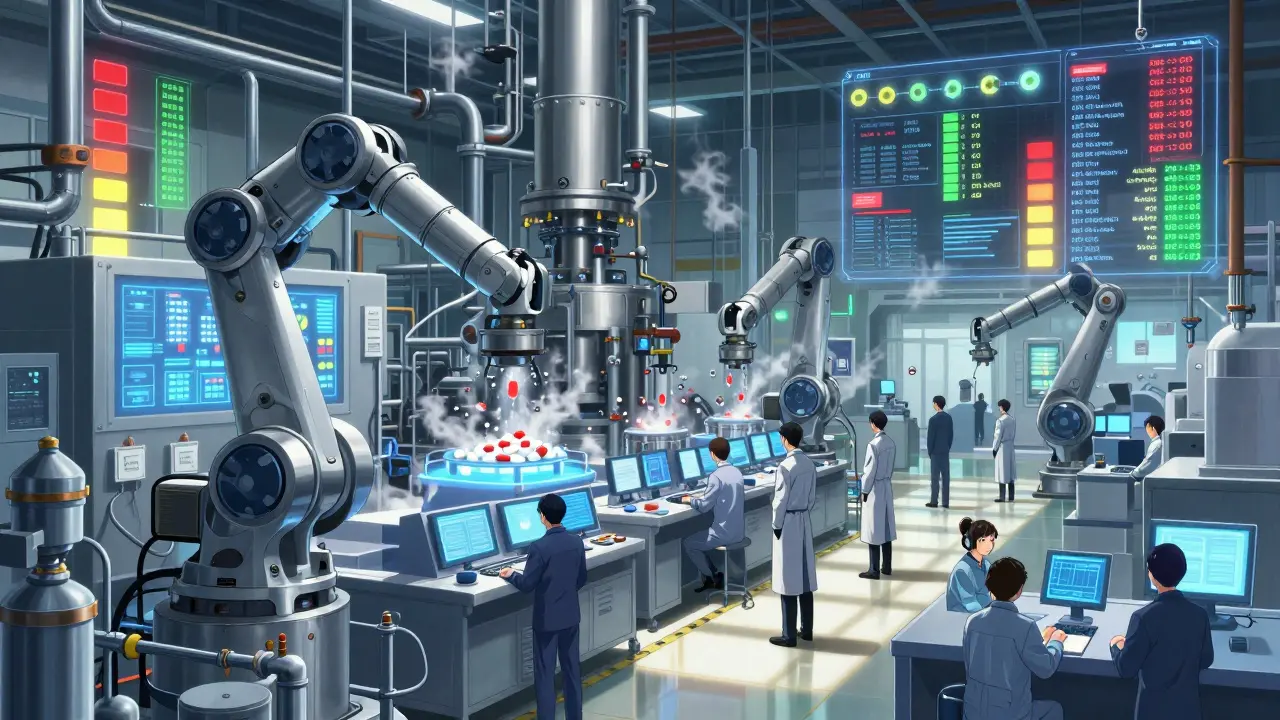
When a pharmaceutical company makes even a small change to how a drug is made-like swapping out a machine, moving a step to a different room, or switching suppliers-it’s not just an internal operational tweak. It’s a regulatory event. The FDA, EMA, Health Canada, and other global agencies treat these changes with serious scrutiny because a tiny shift in the process can affect the safety, strength, or purity of the medicine patients rely on. Getting this wrong can lead to recalls, warning letters, or even a shutdown of production. So how do you know what kind of change needs approval, what can be done with a simple notice, and what’s too risky to touch without permission?
Why Manufacturing Changes Matter
Every drug on the market has an approved manufacturing process. That process isn’t just a recipe-it’s a legally binding set of controls that ensures every pill, vial, or injection delivers the same dose, with the same purity, every single time. When you change equipment, materials, or procedures, you’re altering the conditions under which the drug is made. Even if the final product looks identical, the risk of hidden quality issues increases. A change in the mixing speed of a batch reactor might alter particle size. A new filter could introduce trace contaminants. A different supplier for an excipient might change dissolution rates. These aren’t theoretical risks. In 2023, the FDA issued four warning letters specifically for companies that misclassified equipment changes, including one to Lupin Pharmaceuticals for replacing a lyophilizer without prior approval. That’s not a small oversight-it’s a violation that put patients at risk.The Three-Tier System: FDA’s Approach
The U.S. Food and Drug Administration uses a clear, risk-based system under 21 CFR 314.70 for drugs and 21 CFR 601.12 for biologics. It breaks changes into three categories:- Prior Approval Supplement (PAS) - For major changes. These are the ones that could seriously affect product quality. Examples: changing the synthetic pathway of an active ingredient, moving production to a new facility, or switching to a new type of sterilization process. You cannot distribute the product until the FDA approves your application. This can take 6-12 months.
- Changes Being Effected in 30 Days (CBE-30) - For moderate changes. You can implement the change after submitting the notification, but you must wait 30 days before shipping the product. This applies to things like replacing a tablet press with an equivalent model from the same manufacturer, or changing the packaging material if it doesn’t affect stability. You must have data to back up that the change won’t impact critical quality attributes.
- Annual Report - For minor changes. These are low-risk, like moving a non-critical step within the same building, or updating documentation. You don’t notify the FDA in advance-you just include the change in your annual report, due within 60 days of your application’s anniversary date.
The key is knowing what qualifies as a critical quality attribute (CQA)-the measurable property of a product that must be within an appropriate limit to ensure safety and effectiveness. If your change could affect a CQA, it’s not minor. And if you’re unsure? The FDA’s 2021 final guidance for biologics explicitly says: contact them early. If you guess wrong and they disagree, you could be forced to pull product from the market.
How Other Regions Compare
The U.S. isn’t the only player. Europe, Canada, and the WHO have their own rules-and they don’t always line up.- European Medicines Agency (EMA) uses Type IA (minor, notify within 12 months), Type IB (moderate, approve before implementation), and Type II (major, full review before implementation). Unlike the FDA’s CBE-30, EMA’s Type IB changes require formal approval before you can make the change-no "do and tell" option. But they’ve introduced accelerated pathways for certain equipment changes, cutting approval time from 60 to 30 days.
- Health Canada mirrors the FDA closely: Level I (prior approval), Level II (notify and wait), Level III (annual report). Their guidance is very similar to the U.S., making it easier for companies operating in both markets.
- WHO Prequalification requires a Comparability Protocol for any significant change. This means you must submit a detailed plan showing how you’ll prove the product is still the same after the change-using stability data, bioequivalence studies, and risk assessments.
These differences aren’t just paperwork headaches. A company trying to sell a drug in the U.S. and Europe might need to submit two different packages for the same equipment swap. That’s why the ICH Q12 guideline, adopted in 2020, was created-to harmonize these systems. But full alignment is still years away.
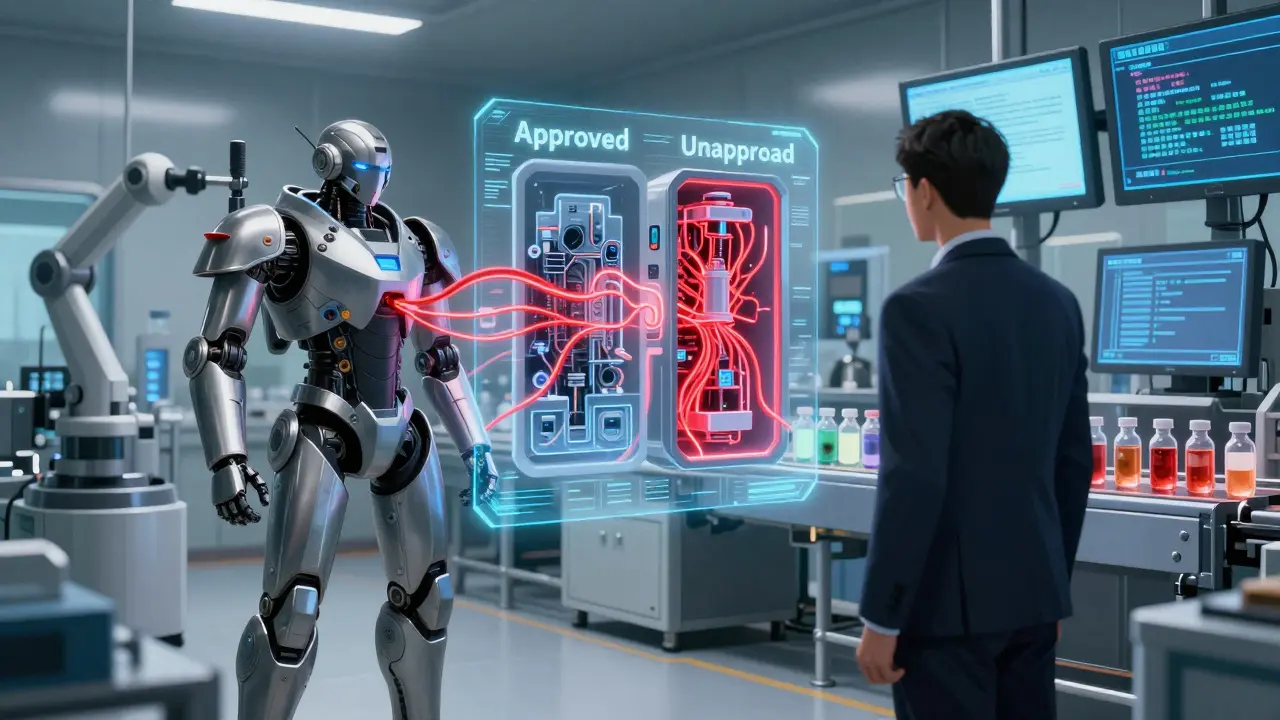
What Counts as a Major Change?
Not all equipment swaps are created equal. The FDA’s 2022 guidance clarifies what "equivalent" really means: same principle of operation, same critical dimensions, same material of construction. If you replace a mixer with one that has the same impeller design and stainless steel construction, it’s likely a CBE-30. But if you switch from a batch mixer to a continuous one-even if it’s from the same vendor-it’s a PAS. Why? Because continuous manufacturing changes how the product behaves throughout the process. The FDA now considers any shift to continuous production a major change, requiring full approval.Other major changes include:
- Changing the source of an active pharmaceutical ingredient (API) to a new supplier with a different synthesis route
- Introducing a new cleaning method that could leave residues
- Modifying the sterilization cycle for a parenteral product
- Switching from single-use to reusable equipment for critical components
One common mistake? Assuming that because a machine is "the same model," it’s automatically equivalent. But if it’s from a different production batch, has different calibration settings, or was installed in a different environment, it might still require a PAS. Data doesn’t lie-FDA inspections show that 37% of manufacturing change violations involve equipment substitutions that were misclassified.
How Companies Handle It in Practice
Large companies like Pfizer have internal risk-scoring tools with 15+ factors: impact on CQAs, process validation status, historical performance, supplier reliability. They assign a numerical score to each change and let the system recommend the reporting category. Smaller companies? They often struggle. On Reddit’s r/Pharmaceutical, a regulatory specialist from a mid-sized generic manufacturer shared that classifying a tablet press replacement took 37 hours of meetings across QA, manufacturing, and regulatory teams-just because the API’s particle size specs were ambiguous.Documentation is non-negotiable. For any change, you need:
- Facility diagrams showing new equipment placement
- Process validation reports comparing old and new
- Comparative batch data from at least three consecutive batches
- Risk assessments using FMEA (Failure Modes and Effects Analysis)
- Stability data proving the product hasn’t degraded
It’s not just about compliance-it’s about proving safety. A 2021 PDA study found that moderate changes require an average of 120 hours of team effort across departments. That’s a lot of time, but it’s less than the cost of a recall.

What’s Changing in 2025?
The regulatory landscape is evolving. The FDA’s 2023 draft guidance on quality risk management pushes companies to use ICH Q9 principles-making the system more flexible and science-based. Companies are starting to use real-time monitoring data from sensors during production to prove that a change didn’t affect quality. Six major pharma firms ran pilot programs in 2022-2023 showing this approach can reduce the need for PAS submissions.Advanced therapies like cell and gene treatments are making things harder. In 2022, 78% of manufacturing changes for these products required PAS submissions because the products are so sensitive. The current system wasn’t built for this. Experts are already calling for specialized frameworks for advanced therapies.
Meanwhile, the European Commission’s 2023 updates to the variation system are making it faster to get approval for certain equipment changes. But the U.S. still lags in allowing "do-and-tell" for minor changes-a flexibility the EMA already offers.
What Happens If You Get It Wrong?
Non-compliance isn’t a slap on the wrist. In FY2022, 22% of all FDA warning letters were tied to manufacturing change violations. The most common? Misclassifying a major change as minor. The consequences:- Product recall
- Import alerts blocking shipments
- Warning letters posted publicly on the FDA website
- Consent decrees forcing plant shutdowns
- Loss of market trust and investor confidence
One company got a warning letter in 2019 after classifying a major API synthesis change as moderate. The FDA found the new method produced a higher level of impurities. The product had to be pulled from shelves. The company lost millions-and months of production time.
How to Avoid Mistakes
If you’re managing manufacturing changes, here’s what works:- Start with risk assessment-use FMEA or a similar tool before even thinking about the change.
- Identify all critical quality attributes affected by the change.
- Compare your change to the FDA’s 2021 guidance table for biologics-it’s the most detailed reference available.
- Document everything. Even if you think it’s minor, write it down.
- When in doubt, consult the FDA. Early communication prevents costly delays.
- Train your team. ASQ data shows it takes 18 months of specialized training for regulators to classify changes consistently.
Manufacturing changes aren’t about avoiding work-they’re about doing the right work at the right time. A well-managed change process doesn’t slow you down. It protects your product, your patients, and your business.
What happens if I make a manufacturing change without notifying the FDA?
If you implement a change that requires prior approval (PAS) or a CBE-30 without submitting the proper notification, you’re in violation of federal regulations. The FDA can issue a warning letter, place an import alert on your product, or order you to stop distribution. In severe cases, they can force a recall or shut down your facility. Even if the product tests fine, the violation itself is enough for enforcement action. There’s no grace period.
Can I use the same equipment from a different manufacturer and still call it "equivalent"?
Not automatically. The FDA defines "equivalent" as having the same principle of operation, same critical dimensions, and same material of construction. Even if the new equipment looks identical, if it’s from a different manufacturer, you must prove it performs the same way under your process conditions. That usually means running comparative batch data and validating performance. If you can’t prove equivalence, it’s treated as a new piece of equipment-and likely requires a PAS.
Do I need to re-validate my entire process after every equipment change?
No, not always. For minor changes, you might only need to validate the specific part affected. For moderate changes (CBE-30), you need to show that the change didn’t negatively impact critical quality attributes-usually through three consecutive batches of data. For major changes (PAS), full re-validation is required. The key is risk-based validation: focus on what’s most likely to change, not everything.
How long does a Prior Approval Supplement (PAS) take to get approved?
The FDA’s standard review time for a PAS is 180 days, but it can take longer if they request additional data. Complex changes-like those involving new facilities or biologics-often take 6 to 12 months. Some companies start the process early, even before finalizing equipment specs, to avoid delays. You can’t ship the product until approval is granted.
Are there any changes that don’t need any notification at all?
Yes-but they’re rare. Only minor changes that have no potential to affect product quality, like updating internal documentation or moving a non-critical step within the same facility, can be reported annually. Even then, you must document the change internally and include it in your annual report. There’s no such thing as a completely unregulated change in pharmaceutical manufacturing.