
Magnesium & Medication Timing Calculator
Your Schedule
Results
Enter your medication times above and click "Check My Schedule" to see if your timing is safe.
⚠️Timing Conflict Detected!
Visual Timeline Guide
Click on any time slot to see what should happen at that point in your day.
Quick Reference: Minimum Spacing Requirements
| Medication Class | Specific Drugs | Interaction Mechanism | Required Separation Time |
|---|---|---|---|
| Thyroid Hormone | Levothyroxine (Synthroid, Tirosint) | Adsorption/Binding | 4 hours after thyroid med |
| Tetracycline Antibiotics | Doxycycline, Minocycline | Chelation | 2 hours before or 4-6 hours after |
| Fluoroquinolone Antibiotics | Ciprofloxacin, Levofloxacin | Chelation | 2 hours before or 6 hours after |
| Penicillins/Macrolides | Amoxicillin, Azithromycin | None Significant | No specific spacing required |
You take your thyroid pill on an empty stomach. You wait an hour before eating. Then you pop a magnesium supplement for better sleep or muscle recovery. It seems harmless enough, but you might be throwing away most of that medication. Magnesium doesn’t just sit quietly in your system; it actively binds to certain drugs in your gut, creating insoluble clumps that your body simply cannot absorb. If you are taking levothyroxine, the standard treatment for hypothyroidism, or specific classes of antibiotics, this binding effect can drastically reduce the effectiveness of your prescription.
This isn't about minor side effects. We are talking about a potential 25% to 35% drop in bioavailability for thyroid meds and up to 50% reduction for certain antibiotics. That means your blood levels of the active drug plummet, leading to returning symptoms, erratic lab results, or treatment failure. The good news? You don’t have to choose between treating your condition and managing your overall health. You just need to master the art of timing.
Why Magnesium Blocks Drug Absorption
To understand why you need to space these doses apart, you have to look at what happens inside your gastrointestinal tract. Levothyroxine contains phenolic, carboxylate, and amine functional groups. When magnesium ions enter the mix-whether from a supplement like magnesium oxide or an antacid-they latch onto these groups. This process is called adsorption. The result is a large, insoluble complex that your intestinal walls cannot penetrate.
Research published in the Journal of Clinical Endocrinology & Metabolism in 2021 confirmed that concurrent administration of magnesium-containing products significantly reduces levothyroxine bioavailability. In practical terms, if you swallow your thyroid med and your magnesium pill at the same time, your body might only absorb a fraction of the intended dose. Over weeks and months, this leads to rising TSH (thyroid-stimulating hormone) levels, even though you feel like you’re being compliant with your medication regimen.
The type of magnesium matters here. Not all supplements behave the same way. Studies indicate that magnesium hydroxide and magnesium carbonate increase levothyroxine adsorption by 40% to 60%. These are common ingredients in over-the-counter antacids like Mylanta. Magnesium oxide, often used for constipation, shows minimal interaction in some isolated studies, but clinical case data tells a different story. Patients taking 400-800 mg of magnesium oxide daily saw their TSH levels jump from healthy baselines to clinically high ranges within just three months. Because individual gut chemistry varies so much, experts recommend treating all magnesium forms as potential interferents unless proven otherwise.
The Golden Rule for Thyroid Medication Timing
If you take levothyroxine, the clock starts the moment you wake up. The American College of Clinical Pharmacy and the Endocrine Society agree on a strict protocol. Take your levothyroxine first thing in the morning with water only. Wait at least 60 minutes before eating breakfast or drinking coffee. This window allows the thyroid hormone to pass through your stomach and into your small intestine where it is best absorbed.
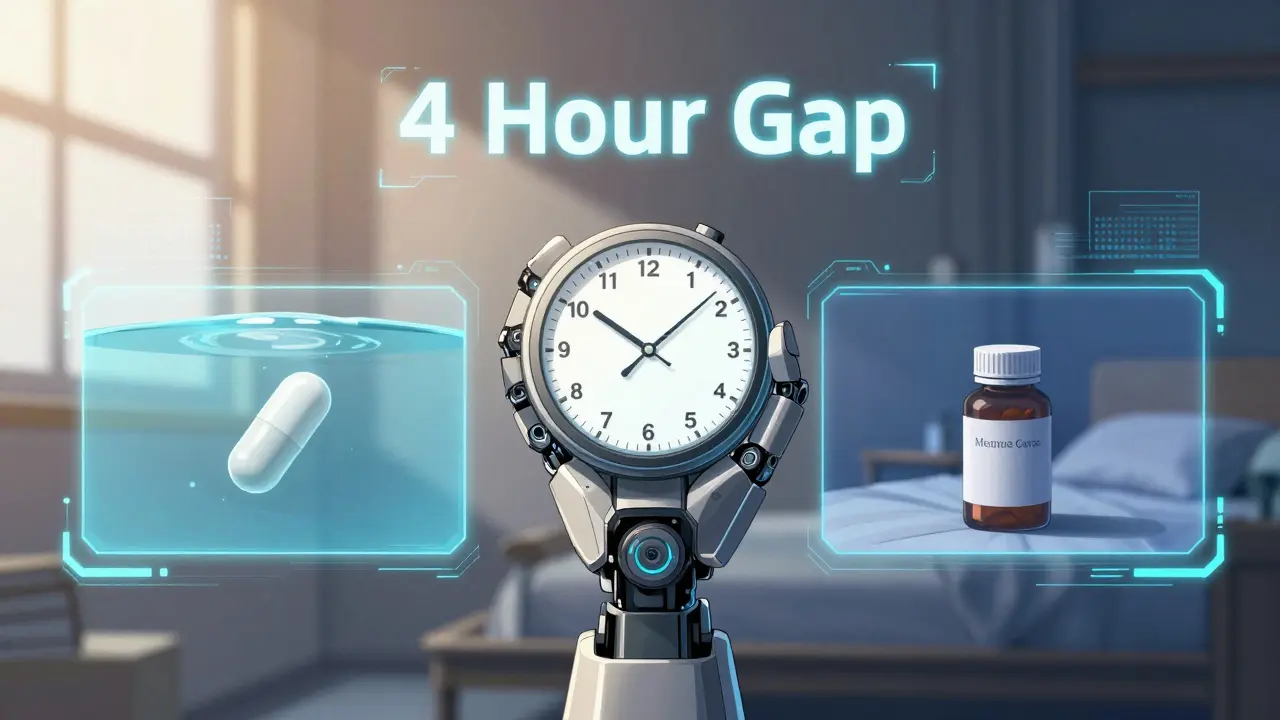
Now, where does magnesium fit in? You should take your magnesium supplement at least four hours after your thyroid medication. For most people, this means taking magnesium with dinner or right before bed. Dr. Elizabeth Pearce, a professor of medicine at Boston University School of Medicine, emphasizes that this four-hour rule is based on gastric emptying times. By waiting this long, you ensure the levothyroxine has cleared the upper GI tract where the binding interaction occurs.
Here is a sample schedule that works for many patients:
- 7:00 AM: Take levothyroxine with water.
- 8:00 AM: Eat breakfast (no calcium or iron-rich foods yet).
- 10:00 AM: If you take iron supplements, take them now (wait 2 hours after breakfast).
- 1:00 PM: Lunch (you can take calcium supplements here if needed).
- 7:00 PM - 9:00 PM: Take magnesium supplement with dinner or at bedtime.
This separation strategy resolved absorption issues for 95% of patients in clinical observations reported by Dr. Pearce. It turns a chaotic medication routine into a predictable one.
Magnesium and Antibiotics: A Different Kind of Clash
Thyroid meds aren't the only ones affected. Certain antibiotics rely on a process called chelation, where they bind to metal ions to be absorbed. When you introduce free-floating magnesium ions into your gut, the antibiotic grabs onto the magnesium instead of passing through your intestinal wall. This renders the antibiotic ineffective, which is dangerous when you are trying to fight an infection.
The two main classes of antibiotics that suffer from this are tetracyclines and fluoroquinolones.
Tetracyclines include doxycycline and minocycline. According to the Infectious Diseases Society of America, you must separate these from magnesium by at least two hours before or four to six hours after. If you take them together, the antibiotic won't reach the bacteria causing your infection.
Fluoroquinolones** include ciprofloxacin and levofloxacin. The FDA labeling for ciprofloxacin states that magnesium can decrease its absorption by up to 50%. A study in Antimicrobial Agents and Chemotherapy showed that taking 500 mg of magnesium citrate with levofloxacin reduced peak plasma concentrations by 37%. The recommendation here is strict: take the antibiotic two hours before or six hours after magnesium.
Not all antibiotics are created equal, however. Penicillin-class antibiotics (like amoxicillin) and macrolides (like azithromycin) do not have significant interactions with magnesium. You can generally take these without worrying about spacing, but always check the patient information leaflet provided by your pharmacist. Life gets complicated when you add other supplements to the mix. Many people with thyroid conditions also take iron and calcium, both of which interact with levothyroxine. If you are juggling levothyroxine, iron, calcium, and magnesium, your day needs to be structured carefully.
The general hierarchy of absorption priority puts levothyroxine first because it requires an acidic, empty stomach environment. Iron follows, needing some food but not competing directly with magnesium later in the day. Calcium and magnesium can often be taken closer together, but separating them from thyroid meds is non-negotiable.
Consider this optimized sequence for a patient on multiple interacting substances:
Using a pill organizer with AM and PM compartments can help enforce this structure. Data from patient reviews on platforms like Drugs.com shows that users who implemented strict spacing protocols saw stable thyroid levels in 78% of cases, compared to only 34% of those who took everything simultaneously. While timing is the primary defense, the form of magnesium you choose can influence your experience. Magnesium glycinate and magnesium malate are often recommended for evening use because they are gentler on the stomach and less likely to cause the laxative effect associated with magnesium oxide or citrate.
Some patients report vivid dreams or sleep disturbances with nighttime magnesium intake. A 2022 survey by the University of Michigan found that 22% of respondents experienced this side effect. If this happens to you, try switching to a different form or moving the dose earlier in the evening, as long as it remains four hours away from your morning thyroid dose. Liquid formulations of levothyroxine, such as Tirosint, have shown reduced interaction potential in clinical trials, with only an 8-12% reduction in bioavailability when co-administered with magnesium, compared to 25-35% for traditional tablets. However, until you switch formulations under doctor supervision, assume the standard tablet rules apply. Don't guess whether your medication is working. Blood tests are the only reliable metric. If you start a new magnesium regimen, ask your doctor to check your TSH levels in 6 to 8 weeks. Dr. Jeffrey Mechanick from Mount Sinai Hospital noted that 87% of patients saw their TSH levels normalize within this timeframe after implementing proper spacing, whereas only 32% improved while continuing concurrent administration.
Be honest with your healthcare provider. A 2023 AMA survey revealed that while 74% of primary care physicians now screen for these interactions, many patients still forget to mention their supplement habits. Your pharmacist is another valuable resource. Chains like CVS and Walgreens now provide "Thyroid Medication Timing Cards" that visually illustrate these schedules. Keep one in your medicine cabinet. Managing magnesium and thyroid medications isn't about restriction; it's about precision. By respecting the biological mechanisms of absorption and adhering to simple timing rules, you protect the efficacy of your prescriptions and maintain your health without unnecessary complications. You should still separate magnesium glycinate from levothyroxine by at least 4 hours. While some newer liquid thyroid formulations show less interaction, standard tablets bind with magnesium regardless of the specific magnesium compound. Taking magnesium glycinate at bedtime and levothyroxine in the morning is the safest approach to ensure full absorption of both. Magnesium is processed relatively quickly, but its presence in the gastrointestinal tract is what causes immediate drug interactions. Once absorbed, excess magnesium is filtered by the kidneys. However, for drug spacing purposes, you only need to worry about the window when both substances are present in your stomach and intestines simultaneously, which is why the 4-6 hours. No, magnesium primarily affects tetracyclines (like doxycycline) and fluoroquinolones (like ciprofloxacin). It does not significantly interfere with penicillins (like amoxicillin) or macrolides (like azithromycin). Always check your specific antibiotic label or consult your pharmacist to confirm if spacing is required. Taking them together can reduce the absorption of your thyroid medication by 25% to 35%. Over time, this leads to elevated TSH levels and a return of hypothyroid symptoms such as fatigue, weight gain, and brain fog, even if you believe you are taking your medication correctly. While some in vitro studies suggest magnesium oxide has lower binding potential than hydroxide, clinical case studies show it can still raise TSH levels significantly. Due to high variability between individuals, medical guidelines recommend treating magnesium oxide with the same 4-hour separation rule as other magnesium forms.
Medication Class
Specific Drugs
Interaction Mechanism
Required Separation Time
Thyroid Hormone
Levothyroxine (Synthroid, Tirosint)
Adsorption/Binding
4 hours after thyroid med
Tetracycline Antibiotics
Doxycycline, Minocycline
Chelation
2 hours before or 4-6 hours after
Fluoroquinolone Antibiotics
Ciprofloxacin, Levofloxacin
Chelation
2 hours before or 6 hours after
Penicillins/Macrolides
Amoxicillin, Azithromycin
None Significant
No specific spacing required
Navigating Complex Regimens

Choosing the Right Magnesium Form
Monitoring and Adjusting
Can I take magnesium glycinate with levothyroxine?
How long does magnesium stay in your system?
Does magnesium affect all antibiotics?
What happens if I take magnesium and thyroid meds at the same time?
Is magnesium oxide safe with thyroid medication?