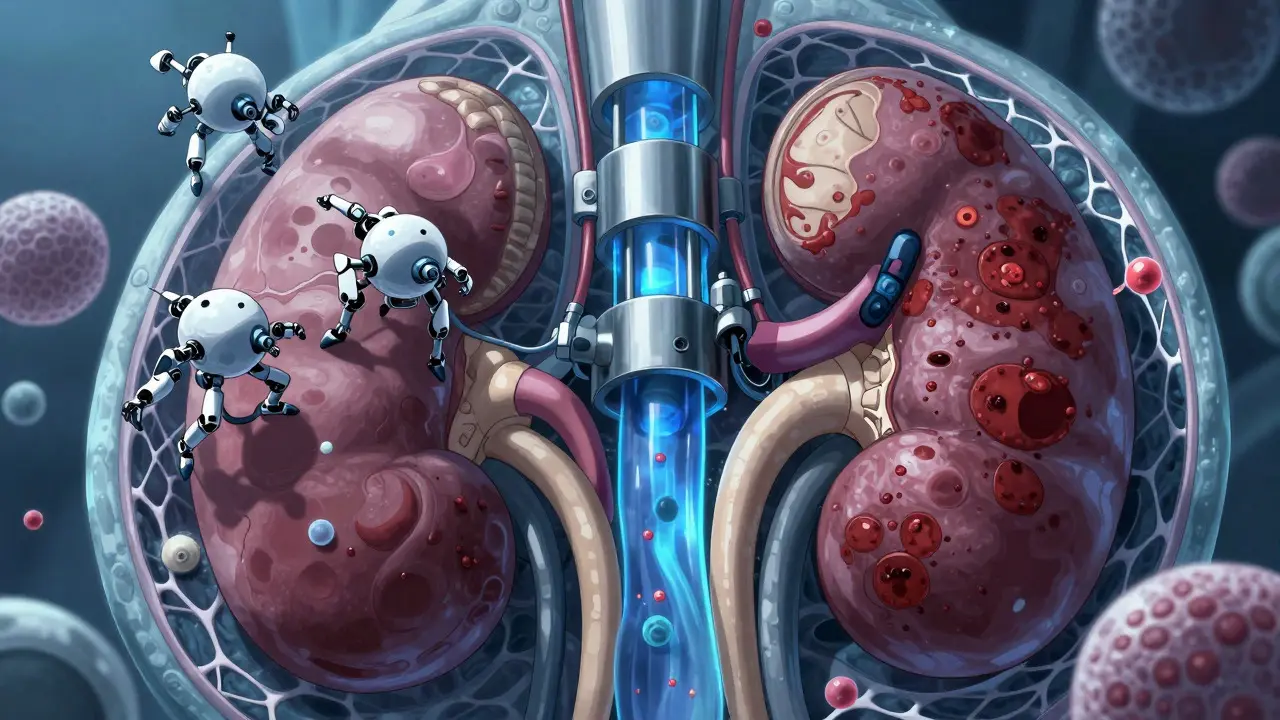
Your kidneys are hardworking filters. Every day, they clean about 150 quarts of blood to produce 1 to 2 quarts of urine, removing waste and extra fluid from your body. But what happens when the immune system-the very force meant to protect you-turns against these delicate structures? This is glomerulonephritis, a condition where inflammation damages the glomeruli, the tiny filtering units within the kidneys. It is not a single disease but a group of disorders that share one common trait: an immune attack on the kidney’s filtration barrier.
If you have been told you have high levels of protein in your urine or noticed swelling in your legs, you might be facing this condition. Understanding glomerulonephritis (GN) is crucial because early intervention can save kidney function. Let’s look at how this happens, what it feels like, and why modern medicine is shifting toward more targeted treatments.
How the Immune System Attacks the Kidneys
To understand GN, you need to visualize the glomerulus as a coffee filter made of three distinct layers:
- The endothelial cells: The innermost layer lining the blood vessels.
- The glomerular basement membrane (GBM): A mesh-like middle layer that acts as the primary sieve.
- The podocytes: Specialized outer cells with foot-like projections that grip the membrane and prevent large proteins from leaking into the urine.
In a healthy kidney, this barrier keeps essential proteins in the blood while letting waste pass through. In glomerulonephritis, the immune system mistakenly identifies parts of this barrier as threats. According to research published in Nature Reviews Immunology (2022), this misidentification triggers inflammation. White blood cells rush to the site, releasing chemicals that damage the podocytes and thicken the basement membrane. When podocytes are injured, they lose their ability to hold tight, causing protein to leak into the urine-a condition known as proteinuria.
This isn’t just a minor glitch. Podocytes have very limited ability to repair themselves. As Dr. Richard Johnson from the University of Colorado noted, once these cells die, they are rarely replaced, leading to permanent scarring (fibrosis) of the kidney tissue over time.
Types of Glomerulonephritis: It’s Not One-Size-Fits-All
Doctors classify GN based on what triggers the immune response and how it looks under a microscope. Knowing the specific type matters because the treatment varies wildly between them.
| Type | Primary Cause/Mechanism | Key Characteristic |
|---|---|---|
| IgA Nephropathy | Abnormal IgA antibodies depositing in glomeruli | Most common primary GN worldwide; often follows respiratory infections |
| C3 Glomerulonephritis (C3G) | Dysregulation of the complement system (specifically C3 protein) | C3 protein accumulates 3-5 times higher than normal in glomeruli |
| Lupus Nephritis | Autoimmune reaction in Systemic Lupus Erythematosus (SLE) | Affects 50-60% of SLE patients; highly variable severity |
| Post-Streptococcal GN | Immune response to a strep throat or skin infection | Common in children; 95% recovery rate within 6-8 weeks |
| Membranoproliferative GN (MPGN) | Immune complex deposition or complement activation | Causes thickening of the glomerular basement membrane |
C3 Glomerulonephritis is particularly interesting because it involves the complement system-a part of the immune system that enhances antibodies. In C3G, this system gets stuck in the "on" position, constantly attacking the kidney. Meanwhile, IgA Nephropathy is driven by issues with IgA antibodies, which usually help protect mucosal surfaces but clump up in the kidneys instead.
Symptoms: What Your Body Is Trying to Tell You
GN often sneaks up on people. Some discover it during a routine blood test showing abnormal kidney function. Others experience dramatic symptoms that fall into two main categories: nephritic syndrome and nephrotic syndrome.
Nephritic syndrome typically presents with:
- Hematuria: Blood in the urine, which may turn it cola-colored or pink.
- Hypertension: High blood pressure due to fluid retention.
- Reduced urine output: Feeling like you’re not peeing enough.
Nephrotic syndrome is more severe and includes:
- Massive Proteinuria: Losing more than 3.5 grams of protein per day.
- Edema: Significant swelling in the legs, ankles, feet, and around the eyes.
- Hypoalbuminemia: Low levels of albumin (a key protein) in the blood, dropping below 3.0 g/dL.
- Hyperlipidemia: High cholesterol levels as the liver tries to compensate for lost proteins.
Patient surveys from the American Kidney Fund reveal that fatigue is the most debilitating symptom for 42% of GN patients. This isn’t just tiredness; it’s a deep exhaustion caused by the body struggling to filter toxins and maintain fluid balance. If you notice persistent puffiness in your face in the morning or shoes that suddenly feel too tight, don’t ignore it.

Diagnosis: Why a Biopsy Is Often Necessary
You cannot diagnose glomerulonephritis with a simple blood test alone. While blood tests can show elevated creatinine (indicating poor kidney function) and urine tests can detect protein, they don’t tell you why the kidneys are failing.
This is why a kidney biopsy is the gold standard. During this procedure, a nephrologist uses a needle to take a tiny sample of kidney tissue. Under a microscope, pathologists look for specific patterns of damage, immune deposits, and scarring.
Is it risky? Yes, but manageable. The complication rate is only 3-5%, mostly involving minor bleeding or pain. However, the insight it provides is invaluable. For example, distinguishing between C3G and immune-complex MPGN changes the entire treatment plan. Without a biopsy, doctors might treat the wrong mechanism, leading to unnecessary side effects and disease progression.
According to patient forums, the average time to diagnosis is 4.2 months from symptom onset, with many seeing multiple specialists before getting answers. Pushing for a biopsy if initial tests are abnormal can speed up this process significantly.
Treatment Options: From Steroids to Targeted Therapies
Historically, the go-to treatment for almost all types of GN was corticosteroids (like prednisone). These drugs suppress the entire immune system, reducing inflammation quickly. About 60-80% of patients respond initially. But there’s a catch: steroids come with heavy side effects.
Within the first year, 72% of patients report significant weight gain, 35% face increased infection risks, and 28% suffer bone density loss. Long-term use can lead to osteoporosis, diabetes, and mood swings. Many patients describe feeling like they traded kidney health for overall well-being.
This is why the field is moving toward targeted immunotherapies. Instead of bluntly suppressing the immune system, new drugs aim at specific pathways.
- Eculizumab: A monoclonal antibody that blocks the complement protein C5. It has shown promise in C3G, reducing proteinuria by 40-50% in some cases. However, it costs approximately $500,000 annually.
- Iptacopan: Recently granted breakthrough therapy designation by the FDA for C3G. Phase II trials showed a 52% reduction in proteinuria compared to placebo.
- Rituximab: Often used for lupus nephritis and IgA nephropathy, it targets B-cells that produce harmful antibodies.
The KDIGO 2023 guidelines recommend trying standard therapy for at least six months before switching to these novel agents, unless the disease is rapidly progressing. Regular monitoring of serum creatinine every two weeks and proteinuria monthly is essential to track progress.

Living with Glomerulonephritis: Practical Steps
Managing GN is a marathon, not a sprint. Alongside medication, lifestyle changes play a huge role in preserving kidney function.
- Control Blood Pressure: Keep it below 130/80 mmHg. ACE inhibitors or ARBs are often prescribed not just for blood pressure but because they reduce pressure inside the glomeruli, slowing protein leakage.
- Limit Salt Intake: Excess sodium worsens edema and hypertension. Aim for less than 2,300 mg per day.
- Monitor Protein Intake: Too much protein can strain damaged kidneys. Work with a renal dietitian to find the right balance-not too little, not too much.
- Avoid NSAIDs: Drugs like ibuprofen and naproxen can reduce blood flow to the kidneys. Use acetaminophen for pain relief instead, unless your doctor says otherwise.
- Stay Vaccinated: Since immunosuppressants increase infection risk, keep up with flu, pneumonia, and hepatitis B vaccines.
Emotional health matters too. Anxiety about disease progression is reported by 51% of patients in support groups. Connecting with others who understand the journey-through organizations like the National Kidney Foundation-can provide immense psychological support.
The Future of GN Care
We are entering an era of precision medicine for kidney disease. Researchers are developing genetic and proteomic profiles to predict how individual patients will respond to treatments. Dr. Richard Lafayette from Stanford University predicts that within five years, personalized therapy selection could increase efficacy from 60-70% to over 85%.
New classification systems now incorporate molecular biomarkers alongside traditional histology, improving prediction accuracy to 85%. While access disparities remain a challenge globally, the rapid growth of the GN treatment market (projected to reach $4.7 billion by 2028) signals increasing investment in better care.
If you suspect you have glomerulonephritis, act fast. Early diagnosis and tailored treatment can halt progression and preserve your kidney function for decades. Don’t wait for symptoms to worsen; advocate for yourself and seek specialized care immediately.
Is glomerulonephritis curable?
Some forms, like post-streptococcal GN, often resolve completely on their own within weeks. Chronic forms like IgA nephropathy or C3G are generally managed rather than cured. The goal is to stop inflammation, prevent scarring, and preserve kidney function long-term. With proper treatment, many people live normal lifespans without reaching end-stage renal disease.
What foods should I avoid with glomerulonephritis?
Focus on limiting sodium (salt) to control blood pressure and swelling. Depending on your kidney function, you may also need to restrict potassium, phosphorus, or protein. Processed foods, canned soups, and salty snacks are major sources of hidden sodium. Always consult a renal dietitian for a personalized meal plan.
How does a kidney biopsy work?
A doctor uses ultrasound to guide a needle into the kidney to extract a tiny tissue sample. You’ll lie on your stomach or side. Local anesthesia numbs the area. Afterward, you’ll rest for several hours to monitor for bleeding. Results typically take a few days to a week, providing critical information for diagnosis.
Can stress cause glomerulonephritis?
Stress doesn’t directly cause GN, which is an immune-mediated disorder. However, chronic stress can weaken the immune system and raise blood pressure, potentially worsening existing kidney inflammation or triggering flares in autoimmune conditions like lupus nephritis. Managing stress is part of holistic care.
What is the life expectancy with glomerulonephritis?
Life expectancy varies widely depending on the type of GN, age at diagnosis, and response to treatment. For example, post-streptococcal GN has an excellent prognosis. IgA nephropathy progresses slowly in many, with 20-40% reaching end-stage renal disease over 20 years. Early detection and adherence to treatment significantly improve outcomes and longevity.