
When someone says they’re allergic to penicillin, it’s often treated like a fact carved in stone. But here’s the truth: up to 90% of people who think they’re allergic to penicillin aren’t. That’s not a guess. It’s backed by data from the American Academy of Allergy, Asthma & Immunology (AAAAI). Around 10% of the U.S. population carries a penicillin allergy label, but most of them never actually had a true immune reaction. They might’ve had a rash after taking the drug as a kid, or their parent said they were allergic, or a doctor wrote it down without testing. Years later, they’re still avoiding penicillin - even though they could safely take it today.
What Really Counts as a Drug Allergy?
Not every bad reaction to a drug is an allergy. An allergy means your immune system has overreacted - usually by producing IgE antibodies - and triggered symptoms like hives, swelling, trouble breathing, or a drop in blood pressure. These typically happen within minutes to an hour after taking the drug. That’s called an immediate-type reaction. If you got a stomachache or a headache after taking ibuprofen? That’s probably just an adverse effect, not an allergy.
Penicillin and related antibiotics like amoxicillin are the most common culprits. But NSAIDs - drugs like aspirin, ibuprofen, and naproxen - also cause real allergic reactions in some people. These reactions often show up as asthma flare-ups, nasal polyps, or hives, especially in adults with chronic sinus issues. Unlike penicillin, there’s no skin test for NSAID allergies. Diagnosis comes from careful history and sometimes a supervised drug challenge.
Here’s the kicker: if you’ve been told you’re allergic to penicillin, you might be missing out on better, cheaper, more effective antibiotics. Doctors often switch you to broader-spectrum drugs like vancomycin or fluoroquinolones. These work, but they’re more expensive, harder on your gut, and increase the risk of resistant infections. Studies show patients labeled penicillin-allergic cost the healthcare system about $500 more per hospital stay just because of antibiotic choices.
How Penicillin Allergy Testing Works
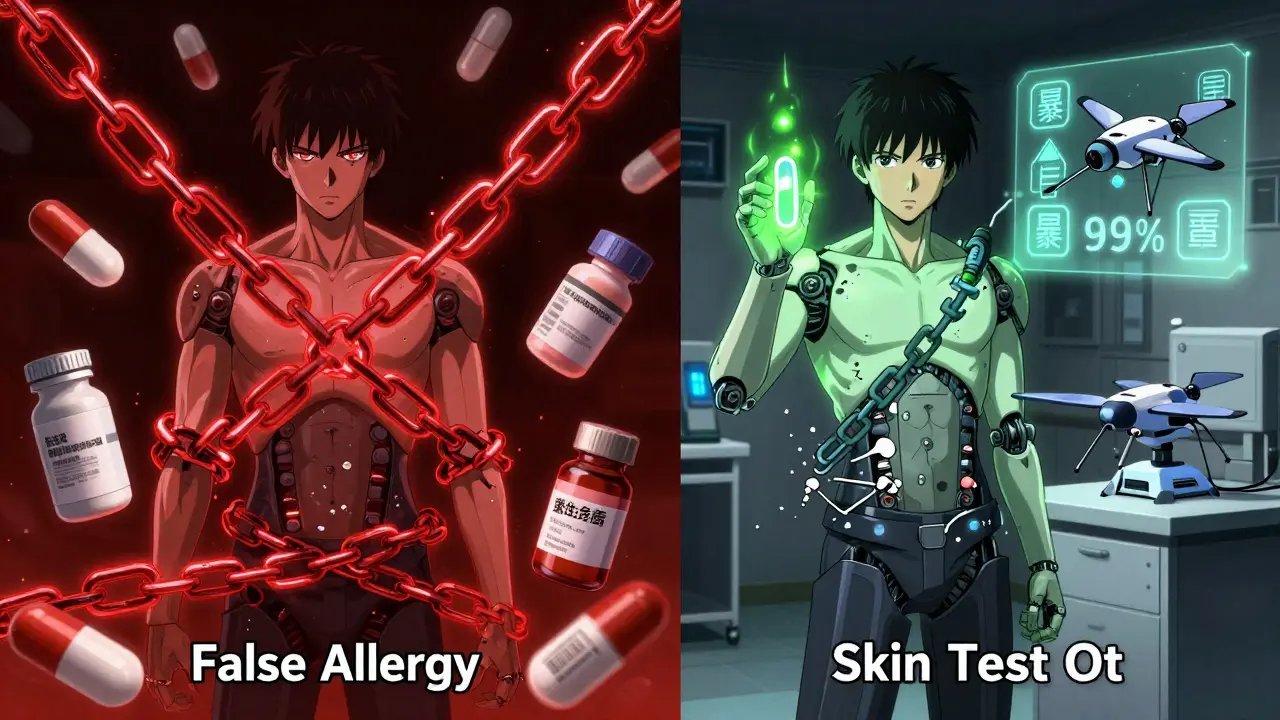
Testing for penicillin allergy isn’t complicated, but it’s underused. The gold standard starts with skin testing using two key components: penicillin G and minor determinant mixture (MDM). These aren’t just the drug itself - they’re specific parts of penicillin that trigger immune responses. If both tests are negative, there’s a 99% chance you’re not allergic.
Then comes the drug challenge. After a negative skin test, you’re given a single full dose of amoxicillin under observation. If you don’t react in the next hour, you’re cleared. No more allergy label. No more unnecessary antibiotics. This isn’t experimental - it’s the standard of care according to the AAAAI.
But here’s where things get messy. Some labs still use a substance called PPL (Prepared Penicillin Polylysine). The problem? Up to 70% of people who test positive to PPL don’t react to actual penicillin. That’s why the AAAAI says PPL shouldn’t be used anymore. If your old allergy test used PPL, your allergy label might be wrong.
NSAID Allergies: A Different Beast
NSAID allergies don’t follow the same rules as penicillin. You can’t skin test for them. There’s no blood test. Diagnosis relies on your history and sometimes a controlled challenge in a clinic.
People with chronic hives, asthma, or nasal polyps are more likely to have NSAID allergies. The reaction often looks like an asthma attack or a sudden flare-up of sinus symptoms. Some people react to one NSAID but can tolerate others. For example, you might react to aspirin but handle ibuprofen fine. That’s why testing one drug at a time matters.
For those who need daily NSAIDs - say, someone with arthritis or heart disease - there’s a solution: desensitization. It’s not a cure, but it’s a way to safely take the drug again. The protocol usually starts with a tiny dose - like 30 mg of aspirin - and slowly increases every 15 to 30 minutes over several hours. Once you reach the full dose, you can keep taking it daily. The tolerance lasts as long as you keep taking it. Stop the drug for a few days, and you’ll need to go through the process again.
What Is Drug Desensitization?
Desensitization is a medical procedure that temporarily turns off your immune system’s reaction to a drug you’re allergic to. It’s not a cure. It’s not permanent. But it’s life-changing for people who need that drug and have no alternatives.
The most common use is for antibiotics - especially penicillin, cephalosporins, and vancomycin - in patients with serious infections. It’s also used for chemotherapy drugs like paclitaxel, which can cause severe reactions in cancer patients. One hospital in Boston has done over 170 desensitizations for paclitaxel alone.
The process is simple in theory: you get tiny, gradually increasing doses of the drug until you reach the full therapeutic amount. For IV drugs, this usually takes 4 to 8 hours. For some antibiotics, like cefazolin, a faster 2-hour protocol works. Oral desensitization is possible too - for example, for antifungal drugs like fluconazole.
Here’s how a typical IV penicillin protocol looks:
- Start with a dose that’s 1/10,000th of the full amount.
- Wait 15 to 20 minutes.
- Dose doubles each time.
- Repeat until you hit the full dose.
It’s done in a hospital or specialized clinic, with emergency equipment ready. Nurses and doctors are trained to spot early signs of a reaction - flushing, itching, wheezing - and stop or treat it immediately. Epinephrine is always on standby.
When Desensitization Is the Only Option
You don’t get desensitized just because you’re nervous about a drug. There are two strict rules:
- You must have a confirmed immediate-type allergic reaction - not just a side effect.
- There must be no safe, effective alternative.
For example, if you have a life-threatening infection and penicillin is the only drug that works, desensitization makes sense. Same with cancer patients who react to chemotherapy but need it to survive. Or someone with rheumatic fever who needs penicillin for life and can’t take anything else.
But if you have a mild rash and your doctor can switch you to azithromycin? Skip the desensitization. It’s risky. It’s time-consuming. It’s not worth it unless you really need the drug.

What Happens After Desensitization?
Once you finish the process, you can take the full dose without reacting. But here’s the catch: the tolerance only lasts as long as you keep taking the drug daily. If you stop for more than 48 hours, your immune system forgets the tolerance. The next time you need the drug, you’ll have to go through the whole desensitization again.
That’s why it’s not used for long-term maintenance - unless it’s for daily NSAIDs in chronic conditions. For antibiotics, it’s usually a one-time event for one course of treatment.
There’s also a small risk of re-sensitization. About 2% of people who were successfully desensitized to penicillin later react again, especially if they received the drug through injection. That’s why some experts recommend repeat skin testing if you’ve had a severe reaction in the past.
Why This Matters for Kids
Most desensitization protocols were designed for adults. But kids need these treatments too - especially those with cancer, cystic fibrosis, or severe infections. The problem? Pediatric guidelines are scarce. A 2019 review in the Journal of Allergy and Clinical Immunology pointed out that most protocols are adapted from adult studies, not built for children.
That’s changing. Hospitals are starting to create pediatric-specific protocols. But progress is slow. Kids react differently. Their weight matters. Their immune systems are still developing. A dose that works for a 180-pound adult could be dangerous for a 40-pound child.
That’s why collaboration matters. Allergists need to work with pediatric infectious disease specialists and oncologists. One team can’t do it alone. The goal? To make desensitization safer and more accessible for kids who need it.
The Bigger Picture
Drug allergies are more than just a label. They affect treatment choices, hospital stays, antibiotic resistance, and even survival rates. Yet most people never get tested. Most doctors don’t know the protocols. And many hospitals still use outdated testing methods.
The solution isn’t complicated. Test people properly. Stop using PPL. Offer skin testing and drug challenges. Train nurses and doctors. Build clear protocols for penicillin, NSAIDs, and chemo drugs. Make desensitization routine for those who need it.
It’s not about fear. It’s about facts. If you think you’re allergic to penicillin, get tested. If you need an NSAID and react to it, talk to an allergist. If you’re a cancer patient with a reaction to chemo, ask if desensitization is an option. These aren’t rare procedures. They’re lifesaving tools - and they’re available right now.